India's café culture has exploded. A decade ago, "getting coffee" meant a small filter coffee shop or a Café Coffee Day outlet in a mall. Today, third-wave specialty roasters are thriving in Bhopal, artisan dessert cafés are doing ₹80,000-a-day revenue in Indore, and a new generation of café entrepreneurs is rewriting the rules of the hospitality business.
The numbers back this up: India's café market is worth ₹8,200 crore and growing at 18% annually. The entry of international chains like Blue Tokai, Third Wave Coffee, and the continued expansion of Starbucks is validating the category — but it's also leaving enormous white space for independent, character-driven cafés that national chains can never replicate.
If you've been dreaming of opening your own café in India — whether it's a cosy pastry-and-coffee spot, a dessert café, or a full all-day dining space — this guide is for you. We'll walk through everything: concept selection, location strategy, the exact investment you'll need, every license you must have, how to engineer a profitable menu, how to market your café, and a clear break-even analysis so you know exactly when you'll start making money.
The India Café Opportunity in 2026
Before we talk about how to open a café, let's understand why now is a compelling time to enter this market.
Urban India's relationship with eating out has fundamentally changed. The post-pandemic urban consumer is more experience-hungry than ever, and café culture sits perfectly at the intersection of work, leisure, and social life. With work-from-anywhere becoming mainstream, people need third spaces — not the office, not home — and cafés are filling that gap beautifully.
The most exciting opportunity isn't in Mumbai or Delhi. It's in tier-2 and tier-3 cities — Jaipur, Indore, Lucknow, Coimbatore, Mysore, Nagpur — where café culture is nascent, rents are a fraction of metro rates, and aspirational young consumers are hungry for quality experiences that their cities haven't yet offered. A well-designed café in Indore can achieve metro-city volumes at tier-2 city costs, yielding margins that metro-city entrepreneurs would envy.
Why Café + Pastry/Bakery Is the Winning Combination
Food margins in cafés are universally higher than beverage margins on a percentage basis, but the real profitability unlock is in-house baking and pastry production. A croissant you buy from an external baker for ₹40 and sell for ₹80 gives you a 50% gross margin. The same croissant produced in-house costs ₹12–15 in ingredients, giving you a 82–85% gross margin. Over hundreds of croissants daily, that difference is transformative.
This is precisely why café owners with pastry skills have a structural competitive advantage. The menu items that drive footfall and loyalty — the signature cake slice, the daily fresh-baked scone, the Instagram-worthy dessert plate — can only be differentiated when you control the production.
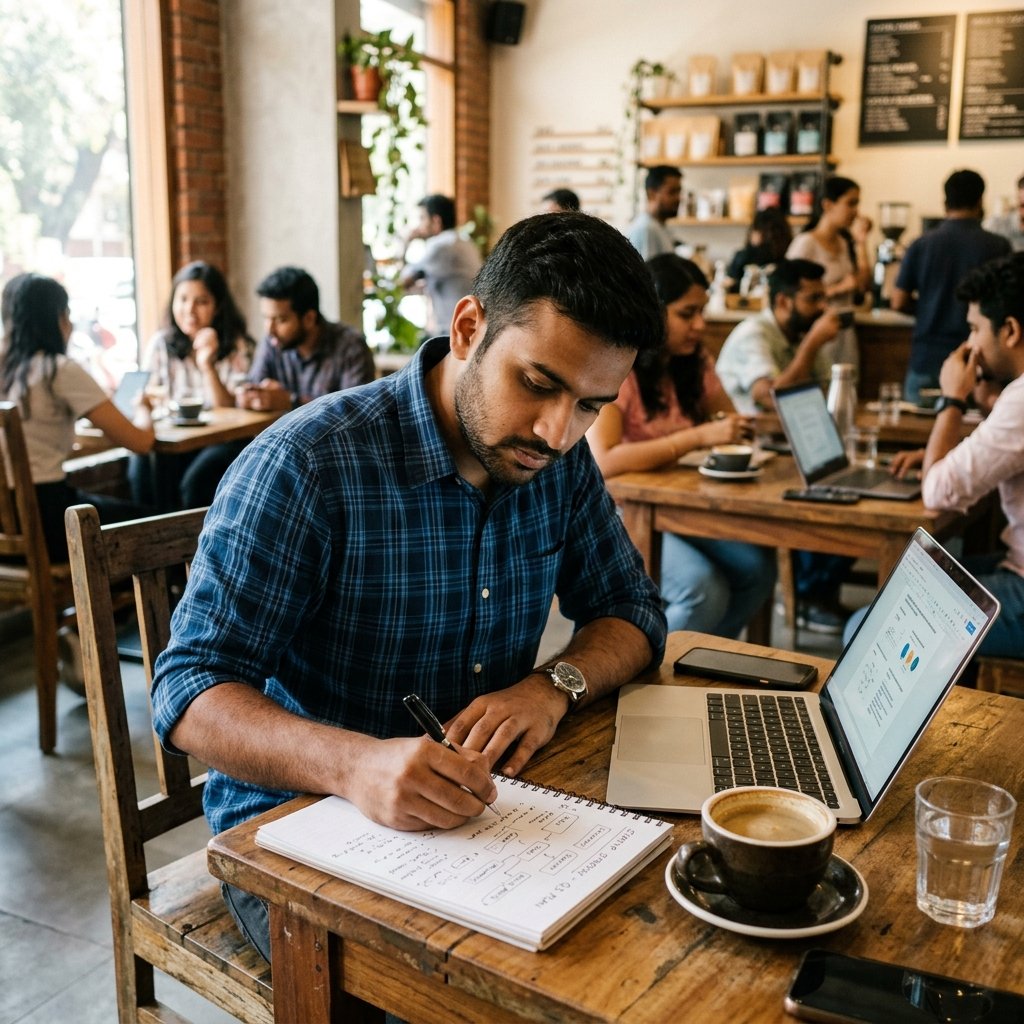
Café Concept Types: Which One Is Right for You?
The first and most important decision you'll make is your café concept. This determines everything downstream: your location, your equipment, your team, your menu, and your target customer.
| Concept Type | Typical Investment | Gross Margin | Primary Revenue Drivers | Difficulty |
|---|---|---|---|---|
| Specialty Coffee + Pastry | ₹10–18L | 62–70% | Coffee (40%), pastries/bakes (45%), retail (15%) | Medium |
| Bakery Café | ₹12–25L | 58–67% | Bread/bakes (50%), beverages (35%), dine-in meals (15%) | Medium |
| Dessert Café | ₹8–15L | 65–72% | Desserts (70%), beverages (25%), merchandise (5%) | Lower |
| All-Day Dining Café | ₹20–50L | 55–65% | Meals (45%), beverages (30%), desserts (20%), events (5%) | High |
| Cloud Kitchen / Delivery Café | ₹3–8L | 60–68% | Delivery orders (85%), pickup (15%) | Lower |
For first-time café owners, the Specialty Coffee + Pastry or Dessert Café model offers the best balance of manageable investment, strong margins, and operational simplicity. If you are leaning toward a French-inspired concept with viennoiserie, entremets, and artisan desserts, our guide on how to open a patisserie in India covers the specific investment, menu planning, and supplier sourcing for that format. The all-day dining model requires significantly more staff, larger kitchen equipment, more complex operations, and higher risk. Master the simpler model first, then expand your offering as you build revenue and confidence.
Location Analysis: Finding Your Perfect Spot
Location is the single biggest variable in your café's success. A great café in the wrong location will struggle. A decent café in the right location will thrive. Get this decision right.
Key Location Evaluation Criteria
- Footfall quality, not just quantity: A road with 5,000 pedestrians who are your target customer (young professionals, students, couples) is infinitely better than a road with 20,000 auto-rickshaw drivers passing through.
- Catchment demographics: Who lives, works, or studies within 500m–1km? What's their income bracket? Are they café-going types?
- Competition: Is there already a café on that street? Is there room for another? Sometimes competition indicates a proven market; other times it's saturated.
- Visibility and accessibility: Ground floor, street-facing, with parking or easy auto/cab access. Basement cafés and upper-floor cafés require exceptional concepts and marketing to drive footfall.
- Rent-to-revenue ratio: Your rent should ideally be under 10–12% of projected monthly revenue. A ₹50,000/month rent café needs to generate ₹4.2–5L monthly revenue to stay healthy.
Location Cost Benchmarks by City Tier
| Location Type | Typical Rent (400 sqft) | Security Deposit | Avg. Cover Price | Monthly Break-even Revenue |
|---|---|---|---|---|
| Metro Prime (Mumbai, Delhi, Bengaluru) | ₹1.2L–₹3L/month | ₹3.6L–₹9L | ₹200–₹400 | ₹5L–₹12L |
| Metro Secondary (Kolkata, Chennai, Hyderabad) | ₹60K–₹1.2L/month | ₹1.8L–₹3.6L | ₹150–₹300 | ₹3L–₹6L |
| Tier-2 Prime (Jaipur, Pune, Indore, Lucknow) | ₹25K–₹60K/month | ₹75K–₹1.8L | ₹100–₹200 | ₹1.5L–₹3.5L |
| Tier-2 Secondary | ₹12K–₹30K/month | ₹36K–₹90K | ₹80–₹150 | ₹80K–₹2L |
| Tier-3 / Small Cities | ₹6K–₹15K/month | ₹18K–₹45K | ₹60–₹120 | ₹50K–₹1.2L |
The opportunity-to-investment ratio in tier-2 cities is outstanding. Rent is 60–80% lower than metros, but cover prices are only 30–50% lower, meaning your cost structure is vastly better while revenue potential is strong. Many of our pastry certification graduates have successfully launched cafés in Jaipur, Indore, and Lucknow with investments under ₹12 lakhs and turned profitable within 8 months.
Investment Breakdown: What Does a Café Actually Cost?
Let's get specific. Here is a realistic investment breakdown for a 400 sq ft specialty coffee + pastry café in a tier-2 city (scale up by 30–50% for metro locations).
| Cost Head | Tier-2 City (₹) | Metro City (₹) | Notes |
|---|---|---|---|
| Security Deposit (2–3 months rent) | 75,000–1,20,000 | 2,40,000–6,00,000 | Refundable on exit |
| Interior Design & Civil Work | 2,00,000–4,00,000 | 5,00,000–12,00,000 | ₹500–1,000/sqft basic to premium |
| Commercial Kitchen Equipment | 2,50,000–5,00,000 | 3,00,000–6,00,000 | Oven, refrigerator, display case, prep tools |
| Espresso Machine + Grinder | 1,20,000–2,50,000 | 1,50,000–4,00,000 | Can rent/lease to reduce upfront cost |
| Furniture, Fixtures & Signage | 1,00,000–2,00,000 | 2,00,000–5,00,000 | Tables, chairs, lighting, display boards |
| POS System + Tech Setup | 25,000–50,000 | 30,000–80,000 | POS, billing, online menu, WiFi |
| Licenses & Registrations | 20,000–50,000 | 30,000–80,000 | FSSAI, Shop Est., GST, Trade License |
| Initial Raw Material Stock | 40,000–80,000 | 60,000–1,20,000 | Coffee beans, flour, dairy, packaging |
| Working Capital (2–3 months) | 1,50,000–3,00,000 | 3,00,000–6,00,000 | Covers rent + salaries until break-even |
| Marketing & Launch Campaign | 30,000–60,000 | 50,000–1,50,000 | Soft launch events, social ads, influencer |
| Total Estimated Investment | ₹10–19 Lakhs | ₹20–45 Lakhs | Varies by concept and city |
Pro tip on equipment: Many espresso machine suppliers (La Marzocco, Nuova Simonelli dealers) offer leasing or revenue-share arrangements where you pay a lower monthly fee in exchange for buying their coffee beans. This can save ₹1–2L in upfront capital.
Ready to master professional baking from home?
Licenses Required to Open a Café in India
Operating a food business without the correct licenses exposes you to fines, closure, and criminal liability. Get these sorted before you open your doors.
| License / Registration | Issuing Authority | Approx. Cost | Timeline | Required For |
|---|---|---|---|---|
| FSSAI Food Business License | FSSAI (State/Central) | ₹2,000–₹7,500/year | 30–60 days | All food businesses |
| Shop & Establishment Registration | State Labour Dept. | ₹1,000–₹5,000 | 7–14 days | Any commercial premises with staff |
| GST Registration | GSTN / Tax Authority | Free | 3–7 days | If annual turnover > ₹20L |
| Trade License | Municipal Corporation | ₹2,000–₹10,000/year | 15–30 days | All retail/service businesses |
| Fire NOC | State Fire Dept. | ₹2,000–₹8,000 | 15–45 days | Any premises with kitchen/cooking |
| Music License (PPL + IPRS) | PPL India / IPRS | ₹8,000–₹25,000/year | 7–14 days | If you play recorded music publicly |
| Eating House License | Local Police/Municipal | ₹1,000–₹5,000/year | 15–30 days | Required in some states (check locally) |
FSSAI: The Most Important License
Your FSSAI Food Business License is non-negotiable and must be obtained before you serve a single customer. Apply at foscos.fssai.gov.in. For cafés with annual turnover between ₹12 lakh and ₹20 crore, you'll need a State License (not just a Basic Registration). The application requires your address proof, food safety management plan, kitchen layout, and proof of water supply.
For a complete walkthrough of the FSSAI process for food businesses, read our detailed guide: FSSAI License for Food Businesses Explained.
Pro Tips on Licensing
- Start the FSSAI application the day you sign your lease — it takes the longest.
- Hire a local CA or licensing consultant (₹5,000–₹15,000 flat fee) who knows your municipal corporation; they'll save you weeks of back-and-forth.
- You can begin interior fit-out while licenses are being processed, but cannot open to the public without FSSAI and Trade License at minimum.
- Keep digital copies of all licenses displayed at your café entrance — it's legally required for FSSAI.
Menu Engineering: Build a Menu That Maximises Profit
Menu engineering is the science of designing your menu so that high-margin, high-popularity items dominate the customer's attention and choices. In a café context, this means putting pastries, specialty coffees, and signature desserts front and centre.
Food Cost Targets
- Specialty coffee drinks: Target 28–35% food cost (65–72% gross margin)
- In-house pastries and bakes: Target 18–25% food cost (75–82% gross margin) — the golden category
- Sandwiches and savouries: Target 30–38% food cost (62–70% gross margin)
- Desserts and plated dishes: Target 25–35% food cost (65–75% gross margin)
- Bottled/packaged beverages: Target 40–50% food cost (50–60% gross margin) — avoid dependence on these
High-Margin Star Items to Feature
| Menu Item | Typical Selling Price | In-House Cost | Gross Margin | Category |
|---|---|---|---|---|
| Signature Croissant | ₹120–₹180 | ₹20–₹28 | 83–85% | Star |
| Espresso / Americano | ₹100–₹180 | ₹18–₹30 | 80–85% | Star |
| Cappuccino / Latte | ₹140–₹220 | ₹30–₹45 | 78–82% | Star |
| Slice Cake (per portion) | ₹150–₹250 | ₹28–₹45 | 80–83% | Star |
| Tart / Éclair | ₹120–₹200 | ₹22–₹38 | 80–84% | Star |
| Grilled Sandwich | ₹180–₹300 | ₹55–₹95 | 65–70% | Workhorse |
| Cold Coffee (in-house) | ₹180–₹280 | ₹35–₹60 | 77–80% | Star |
| Packaged Juice / Bottled Water | ₹60–₹120 | ₹35–₹65 | 40–48% | Dog |
Notice the pattern: anything you bake or prepare entirely in-house commands the highest margins. This is why investing in pastry and baking skills is one of the highest-ROI decisions a café owner can make. Read our guide on Bakery Pricing Strategy to understand how to price your baked goods for maximum profitability.
Menu Size: Less Is More
Resist the temptation to offer everything. A focused menu of 15–25 items is operationally superior to a sprawling 60-item menu. It reduces waste, simplifies staff training, enables consistent quality, and makes purchasing more efficient. Start tight, add items only when you have data showing customer demand.
Staffing: Building Your Café Team
Labour is your second-largest cost after rent. Hire too few and service suffers; hire too many and margins collapse. For a 400–600 sq ft café serving 60–100 covers daily, here's a realistic staffing model.
| Role | Headcount | Monthly Salary Range | Key Responsibilities |
|---|---|---|---|
| Café Manager / Head Barista | 1 | ₹18,000–₹30,000 | Coffee, customer relations, daily ops |
| Kitchen / Prep Staff | 1–2 | ₹12,000–₹18,000 | Food prep, plating, baking support |
| Service / Cashier | 1 | ₹10,000–₹15,000 | Table service, billing, order taking |
| Cleaning / Utility | 1 (part-time) | ₹5,000–₹8,000 | Cleaning, dishwashing, restocking |
| Total Monthly Payroll | 3–5 people | ₹45,000–₹71,000 |
Owner-operator advantage: If you as the owner work in the café — especially handling baking and pastry production — you eliminate the need for a skilled kitchen hire and improve quality control. This is the single biggest structural cost advantage for owner-operators versus absentee café investors.
Staff Training is Non-Negotiable
Invest 2–3 weeks in training before opening. Every staff member should know the full menu, allergen information, how to handle customer complaints, and your café's story and values. A well-trained team of 4 will outperform a poorly trained team of 8 every time.
Break-Even Analysis: When Will You Start Making Money?
Let's run a realistic break-even calculation for a tier-2 city café. Understanding this number is critical — it's your target, your benchmark, and your north star for the first year.
Monthly Fixed Costs (Tier-2 City, 400 sqft)
| Fixed Cost Item | Monthly Cost (₹) |
|---|---|
| Rent | 35,000 |
| Staff Salaries (4 people) | 55,000 |
| Utilities (electricity, water, gas) | 12,000 |
| Internet + POS Subscription | 3,000 |
| License Renewals (amortised) | 2,000 |
| Marketing + Social Media | 8,000 |
| Loan EMI / Capital Repayment | 15,000 |
| Miscellaneous (maintenance, packaging) | 8,000 |
| Total Monthly Fixed Costs | ₹1,38,000 |
Break-Even Calculation
Assuming a blended gross margin of 65% (a realistic target for a coffee + pastry café with in-house baking):
Break-Even Revenue = Fixed Costs ÷ Gross Margin = ₹1,38,000 ÷ 0.65 = ₹2,12,300/month
That's approximately ₹7,077 per day. At an average ticket size of ₹120 per cover, you need roughly 59 covers daily — about 20 covers at breakfast, 25 at lunch, and 14 in the evening. This is entirely achievable for a café in a decent location.
Most well-located, well-operated cafés hit break-even between 6 and 12 months of opening. Cafés with in-house baking capabilities tend to reach profitability faster because of superior food margins. Build your cash reserve to cover 3 months below break-even — this is your safety net while you build your customer base.
For a comprehensive guide to café and bakery financial planning, see our post on Creating a Bakery Business Plan.
Ready to master professional baking from home?
Digital Marketing for Your Café
The best café in the world fails if no one knows it exists. Marketing is not optional — it's the lifeblood of a new café. Here's where to focus your energy and budget.
1. Google My Business (Free — Do This First)
Set up your Google My Business profile the day you finalise your location. Complete every field: photos, hours, services, price range, menu. A well-optimised GMB listing appears in "café near me" searches — which represent the highest-intent queries you'll ever receive. This is completely free and drives enormous walk-in traffic.
2. Instagram: Your Visual Storefront
For a café, Instagram is not optional. Your target customers discover new cafés primarily through Instagram. Build your account before you open — document the fit-out, the first bake, the coffee calibration session. Create a visual identity with consistent filters, your café's colour palette, and a clear aesthetic. Post at minimum 4 times per week: product close-ups, behind-the-scenes, customer moments, and menu specials.
Partner with 3–5 local food bloggers and micro-influencers (5,000–50,000 followers) for a complimentary preview experience before your launch. Nano-influencers in tier-2 cities often charge nothing for a genuine, well-designed collab.
3. Zomato and Swiggy: Delivery Revenue from Day One
List on Zomato and Swiggy immediately upon opening. Delivery revenue can represent 25–40% of a café's total revenue, especially for dessert cafés and bakery cafés. It also builds brand awareness — people who order from you online often come in for the dine-in experience later. Zomato listing is free; Swiggy charges a commission (18–25%) on orders, so price your delivery menu accordingly.
4. WhatsApp and Email: Build Your Community
From day one, collect customer contact details — WhatsApp number and email — with consent. Build a WhatsApp broadcast list for daily specials, new menu launches, and special events. This is the most cost-effective marketing channel you have and builds genuine community loyalty. Aim for 200 contacts in your first month; 1,000 by month six.
5. Hyper-Local Paid Ads
Once you have ₹5,000–₹10,000/month for paid marketing, run Facebook and Instagram ads targeting a 3–5km radius around your café. Use video content of your freshest bakes coming out of the oven, or an aesthetic Reels-style tour of your café space. Hyper-local café ads on Meta perform extremely well at low budgets when the creative is compelling.
10-Step Launch Checklist
- Finalise Your Concept and Business Plan Choose your café model, define your target customer, build a financial model with break-even analysis. Write a one-page business plan.
- Secure Your Location and Sign Lease Evaluate minimum 8–10 locations on footfall, demographics, rent, and visibility before signing. Negotiate a 2-year lease with a 1-year lock-in.
- Apply for FSSAI License (Day 1 of Lease) Apply at foscos.fssai.gov.in immediately. Takes 30–60 days. Engage a consultant if needed.
- Register Your Business and GST Register as a Sole Proprietorship, LLP, or Pvt Ltd depending on your scale and plans. Apply for GST if projected turnover exceeds ₹20L.
- Begin Interior Fit-Out Hire a local interior designer or café fit-out contractor. Finalise kitchen layout first (functional), then front-of-house aesthetics (experiential).
- Source Equipment and Set Up Kitchen Procure commercial-grade espresso machine, oven, refrigerators, display case, and prep equipment. Commission and test all equipment before staff arrives.
- Hire and Train Your Team Recruit 3–5 staff 4 weeks before opening. Run 2 weeks of intensive training on menu, service standards, and café story before soft launch.
- Set Up Digital Presence Google My Business, Instagram, Zomato/Swiggy listings. Build 500+ followers on Instagram before opening day through pre-launch content.
- Soft Launch (Friends and Family Week) Operate for 5–7 days with invited guests only. Identify and fix operational gaps, refine your menu, calibrate your barista, and gather feedback.
- Grand Opening and Marketing Push Launch with an event, influencer coverage, and a paid social media campaign. Offer a compelling opening special. Track daily covers and revenue from day one.
- FSSAI License Obtained
- Shop & Establishment Registered
- Trade License Secured
- GST Registered
- Fire NOC in Hand
- Kitchen Equipment Commissioned
- Staff Hired and Trained
- Google My Business Live
- Zomato/Swiggy Listed
- Insurance Policy Active
Ready to master professional baking from home?
Café Interior Design and Ambience on a Budget
Your café's interior is not mere decoration — it is your brand made physical. In a market where customers choose cafés as much for the atmosphere as for the coffee, interior design directly drives footfall, dwell time, average ticket size, and Instagram shareability. But "great design" does not require a ₹20-lakh fit-out budget. Some of the most photographed cafés in India were built on surprisingly tight budgets with clever material choices and a coherent design language.
Design Principles That Work for Indian Cafés
Pick one aesthetic and commit. The biggest mistake first-time café owners make is mixing too many styles — a bit of industrial, some Scandinavian, a touch of Rajasthani. The result is visual noise. Choose a clear direction: warm minimalist, rustic artisanal, tropical botanical, or urban industrial. Then execute it consistently across walls, furniture, tableware, lighting, and even your menu card design.
Lighting is 50% of your ambience budget. Nothing transforms a space more dramatically than lighting. Warm-toned pendant lights (2700K–3000K colour temperature) over tables, accent lighting on your display counter, and absolutely no overhead fluorescent tubes. Budget ₹30,000–₹60,000 specifically for lighting — it is the highest-ROI design spend you'll make.
Your display counter is your silent salesperson. Invest in a quality glass display case (₹40,000–₹80,000) and position it so every customer walking in sees your croissants, cakes, and pastries front and centre. A well-merchandised display case can increase pastry sales by 30–40% compared to a menu-only approach. This is where your commercial bakery equipment investment pays off visually.

Budget-Friendly Interior Hacks
- Exposed brick or textured wall paint (₹5,000–₹15,000): One accent wall with exposed brick texture or lime wash creates depth and character without expensive materials.
- Open shelving with props (₹8,000–₹12,000): Display coffee bags, ceramic mugs, baking equipment, and plants on simple wooden shelves — it doubles as decor and retail opportunity.
- Green wall or potted plants (₹3,000–₹8,000): A cluster of indoor plants in the seating area adds life, improves air quality, and photographs beautifully. Low-maintenance varieties like money plants, pothos, and snake plants work best.
- Custom signage and chalkboard menu (₹5,000–₹15,000): A hand-lettered chalkboard menu or a custom neon sign with your café name becomes a photo backdrop that customers share organically.
- Mix-and-match seating (₹40,000–₹80,000): Instead of buying identical chairs, mix 2–3 styles — wooden chairs, cushioned benches, bar stools at a window counter. It creates visual interest and saves money by letting you source from multiple vendors.
Interior Design ROI Insight
Research by the National Restaurant Association of India (NRAI) suggests that cafés with a cohesive, Instagram-friendly design concept see 25–35% higher customer acquisition from social media compared to functionally designed but visually generic cafés. In practical terms, spending an extra ₹1–2 lakh on thoughtful interior design can pay for itself within 3–4 months through organic social media reach alone. Your café's aesthetic is not vanity — it is a customer acquisition channel.
Technology Stack for Modern Café Operations in India
Running a café in 2026 without the right technology is like trying to bake without a thermometer — technically possible, but you're flying blind and will make expensive mistakes. Fortunately, the Indian SaaS ecosystem now offers affordable, purpose-built tools for small food businesses. Here is the technology stack every new café owner should implement from day one.
Essential Technology: POS and Billing
Your Point of Sale (POS) system is the central nervous system of your café. It handles billing, tracks inventory, generates sales reports, manages GST compliance, and integrates with delivery platforms. Do not use a manual billing book — even if you're on a tight budget, a basic cloud POS costs ₹500–₹2,000/month and will save you hours of manual work and prevent billing errors.
| Feature | Budget POS (₹500–₹1,500/mo) | Mid-Range POS (₹1,500–₹4,000/mo) | Premium POS (₹4,000–₹8,000/mo) |
|---|---|---|---|
| Billing & GST Invoicing | Yes | Yes | Yes |
| Inventory Tracking | Basic | Detailed with alerts | Auto-reorder, recipe-level |
| Zomato/Swiggy Integration | Manual sync | Semi-automated | Full auto-accept |
| Customer CRM & Loyalty | No | Basic (points) | Advanced (segmentation, campaigns) |
| Staff Management | No | Shift scheduling | Performance, tips, attendance |
| Best For | Solo/kiosk cafés under ₹2L/mo revenue | Small cafés ₹2–8L/mo revenue Best Value | Multi-outlet or ₹8L+/mo revenue |
| Example Providers | Khata Book, Posist Lite | Petpooja, DotPe, UrbanPiper | POSist, LimeTray, Torqus |
For a café generating ₹2–5 lakh monthly revenue, a mid-range POS system offers the best value. It handles your billing, tracks what's selling (and what's not), manages inventory waste, and integrates with delivery platforms — all of which directly impact your profitability. Most offer free trials, so test 2–3 before committing.
Digital Payments: UPI is Non-Negotiable
In 2026 India, 65–80% of café transactions happen digitally — primarily via UPI (PhonePe, Google Pay, Paytm). Set up a business UPI ID, display QR codes at every table and the billing counter, and ensure your POS supports UPI reconciliation. Accept all major digital wallets, debit/credit cards (via a ₹2,000–₹5,000 card terminal), and cash. Never turn away a customer because of a payment method limitation.
Online Ordering and Delivery Management
Beyond Zomato and Swiggy, consider setting up your own ordering page (via DotPe, Thrive, or a simple WhatsApp Business catalog). Direct orders avoid the 18–25% delivery platform commission and let you build a direct customer relationship. Many successful Indian cafés now generate 15–20% of their delivery revenue through direct channels — that commission saved goes straight to your bottom line.
Start with a mid-range POS (₹1,500–₹3,000/month), UPI payments, and listings on Zomato and Swiggy. Add a direct ordering channel by month 3. This technology stack costs ₹3,000–₹5,000/month total and will save you 8–10 hours per week in manual work while giving you the data you need to optimise your menu, pricing, and staffing. The cafés that thrive in 2026 are the ones that treat technology as a profit lever, not an overhead expense.
Common Mistakes First-Time Café Owners Make in India
We've spoken to hundreds of aspiring café owners through our pastry certification programme, and we've seen the same mistakes repeated across cities, budgets, and concepts. Here are the most damaging ones — and how to avoid them. If you're also considering a home bakery as a stepping stone, many of these lessons apply equally to that format.
1. Overspending on Interiors, Underspending on Working Capital
This is the number one killer of new cafés in India. Entrepreneurs pour 60–70% of their budget into a stunning fit-out, then run out of cash within 3 months of opening because they didn't budget enough working capital. Your café will not reach break-even on day one — you need 2–3 months of runway (rent + salaries + raw materials) as a buffer. A beautiful café that closes in 4 months because of cash flow is worse than a simple café that survives year one and improves as revenue grows.
2. Menu Too Large, Execution Too Thin
Offering 60 items when you should offer 20 creates waste, inconsistency, slow service, and confused customers. A focused menu of 15–25 well-executed items outperforms a sprawling menu every time. Start with your strongest 15 items, measure sales data for 30 days, then add or remove items based on actual demand — not assumptions. Your bakery profit margins will thank you for restraint.
3. Ignoring Food Cost Tracking
Many first-time café owners know their rent and salary costs but have no idea what their actual food cost percentage is. They don't track ingredient usage, don't measure waste, and don't calculate item-level margins. This is like driving without a speedometer. Set up a weekly food cost tracking sheet from day one — weigh ingredients, record waste, and calculate your actual vs. target food cost for each item category.
4. No Pre-Opening Marketing
Opening your doors and hoping people walk in is not a strategy. Your Instagram account should be active 6–8 weeks before your café opens. Document the journey — the lease signing, the first wall being painted, the equipment arriving, the first batch of croissants coming out of the oven. Build anticipation. On opening day, you should already have 500+ followers who feel invested in your story. For more on leveraging social media for food businesses, read our bakery social media marketing guide.
5. Choosing Location Based on Rent Alone
A ₹15,000/month rent in a dead lane with no footfall is more expensive than a ₹40,000/month rent on a busy high street — because you'll never generate the revenue to justify any rent in the wrong location. Always evaluate location on footfall quality, not rent per square foot. Spend 3 full days at any prospective location, counting pedestrians and observing demographics, before signing a lease.
Impact rating: how much each factor affects first-year café survival and profitability
Franchise vs. Independent Café: Which Path Should You Choose?
One of the first decisions aspiring café entrepreneurs face is whether to buy into a franchise brand or build an independent café from scratch. Both paths have genuine merits, and the right choice depends on your budget, risk appetite, creative ambition, and long-term vision. Let's break it down honestly.
| Factor | Franchise Café | Independent Café |
|---|---|---|
| Initial Investment | ₹15–50L (franchise fee + setup) | ₹8–25L (full control over spend) |
| Ongoing Royalties | 5–8% of revenue + marketing levy | None |
| Brand Recognition | Immediate (day-one awareness) | Built from zero (takes 6–12 months) |
| Menu Freedom | Very limited (franchisor-mandated) | Complete (your creativity, your menu) |
| Training & SOPs | Provided by franchisor | You develop yourself (or via courses like ours) |
| Supplier Flexibility | Restricted (approved vendors only) | Full flexibility (negotiate your own deals) |
| Profit Margins (Net) | 8–15% (after royalties) | 15–25% (no royalties) |
| Exit/Resale Value | Subject to franchisor approval | Fully yours to sell or expand |
| Best For | Risk-averse investors wanting a proven model | Passionate operators who want creative control Recommended |
Popular café franchises in India include Chai Point (₹10–15L), The Belgian Waffle Co. (₹12–18L), Chaayos (₹15–25L), and larger brands like Starbucks and Blue Tokai which don't typically franchise. The franchise model works if you want a plug-and-play business with proven SOPs and are comfortable with restricted creativity and ongoing royalty payments.
However, for entrepreneurs who want to build a genuinely differentiated café — especially one centred on artisan pastries, specialty coffee, and a unique neighbourhood identity — the independent route offers significantly higher margins, complete creative control, and the ability to build a brand that you own entirely. The key risk of the independent route is that you must develop operational knowledge yourself, which is exactly what structured training and planning compensates for.
Café Revenue Model: Where the Money Actually Comes From
Understanding your revenue mix is critical for making smart decisions about menu development, staffing allocation, and marketing spend. Here is a typical revenue breakdown for a well-run specialty coffee and pastry café in India, based on industry data and our conversations with café-operating alumni.