Every week, thousands of home bakers across India start selling their cakes, cookies, and breads — and most of them are doing it without a clear understanding of food safety. That's a problem. Not because inspectors are knocking on their doors (though that's increasingly happening), but because a single food safety incident can end a home bakery career overnight.

Food poisoning claims, allergen reactions, contaminated products — these are not hypothetical risks. They are real events that happen to real bakers, and the consequences range from damaged reputations and lost customers to legal liability and criminal charges under India's food safety law. The good news is that following food safety protocols is neither complicated nor expensive. It requires knowledge, habit, and consistency — all things a committed baker can absolutely master.
This guide gives you everything: the legal requirements under FSSAI, the personal hygiene standards that protect your customers, the kitchen sanitation protocols that prevent contamination, the allergen management rules you cannot afford to ignore, and the practical labeling and packaging requirements for selling food commercially in India. Whether you're just starting your home bakery or are already established and want to formalise your practices, this is your complete reference.
Why Food Safety Matters for Home Bakers: Legal and Reputational Stakes
Let's start with the legal reality. India's Food Safety and Standards Act, 2006 (FSSA) governs every person or entity that manufactures, processes, stores, distributes, or sells food — including home bakers who sell directly to customers, through Instagram, or on delivery platforms like Swiggy and Zomato. There is no exemption for small-scale or home operations. If money changes hands for food you have made, you are a food business operator (FBO) in the eyes of the law.
The penalties for non-compliance are severe. Selling food without a valid FSSAI license or registration attracts fines of up to ₹5 lakh. Selling sub-standard food can result in fines up to ₹5 lakh and criminal prosecution. If your product causes injury or death, the penalties escalate dramatically — up to life imprisonment in cases of gross negligence resulting in death. These are not theoretical worst-case scenarios; FSSAI enforcement activity has increased significantly since 2022, and home food businesses have been targeted in major cities.
Beyond legal risk, there is the reputational reality that every baker who sells online understands intuitively: your reputation lives and dies by word of mouth and online reviews. A single customer who gets food poisoning from your product — and posts about it on Instagram or a WhatsApp group — can undo months of brand-building in 24 hours. The baking community in India is wonderfully connected, and that connectivity works against you the moment something goes wrong.
But the most important reason to care about food safety is none of the above. It's simply this: your customers trust you with their health, and often with the health of their children and families. That trust is the foundation of your business, and it deserves to be honoured with the highest standards of care.
Food safety is not optional for home bakers in India. It is a legal requirement, a business protection strategy, and a moral obligation to the customers who trust you. Fortunately, with the right knowledge, implementing food safety standards is straightforward — and it makes you a significantly more confident, competent baker.
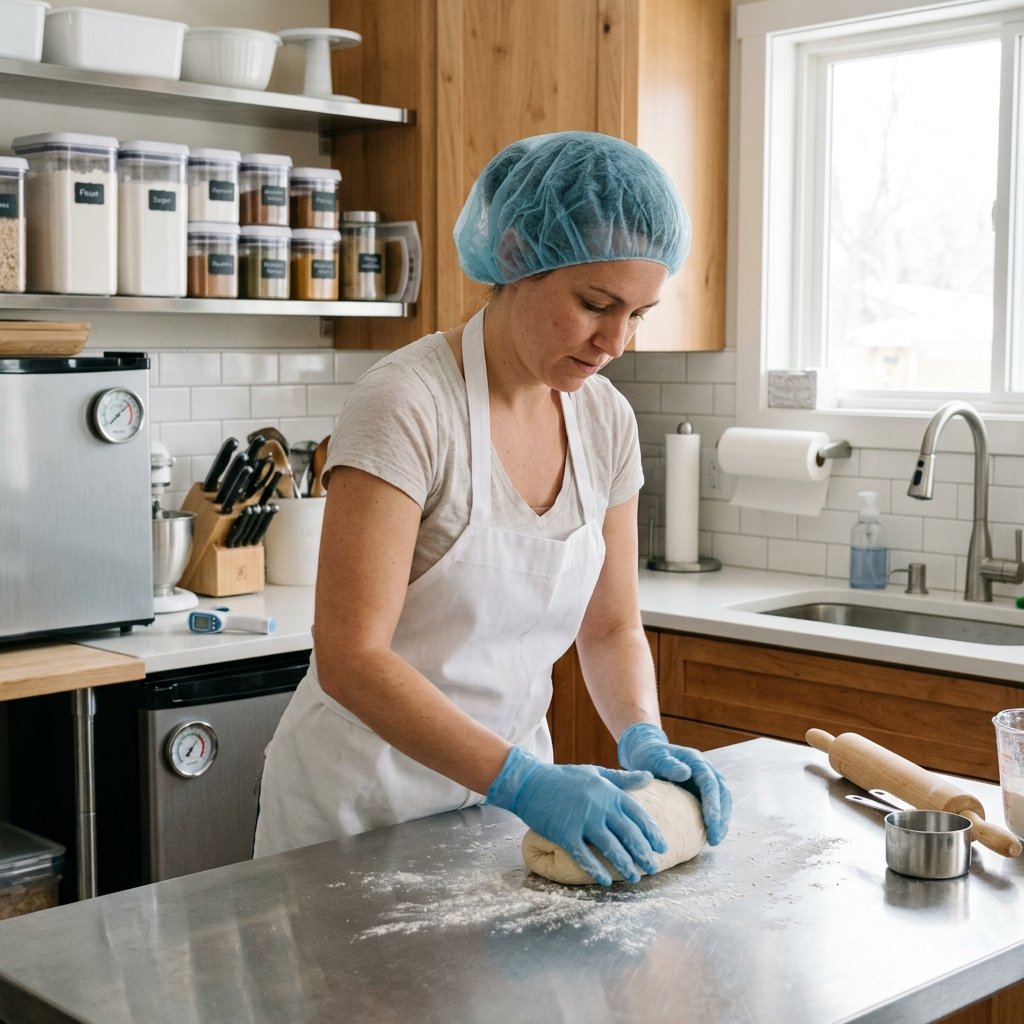
Personal Hygiene Requirements for Bakers
Personal hygiene is the single most impactful food safety measure available to any baker. According to food safety researchers, human handlers are responsible for the majority of foodborne contamination events. Your hands, hair, skin, and breath are potential vehicles for harmful bacteria — and the kitchen provides constant opportunities for cross-contamination if hygiene habits are not rigorous.
The Non-Negotiable Hygiene Protocols
Handwashing: The Single Most Important Habit
Wash hands with soap and warm water for a minimum of 20 seconds before starting any baking session, after touching raw eggs, dairy, or meat (if applicable), after using the toilet, after touching your face or hair, after handling waste or packaging, and after sneezing or coughing. Use a dedicated hand-washing sink — not the same sink used for food preparation or equipment washing. Dry hands with clean paper towels, not cloth towels, which can harbour bacteria.
Hair Containment
All hair must be fully covered during food preparation. Use a hair net, baker's cap, or tightly secured head covering. This applies to both scalp hair and facial hair. Hair in food is not just a quality issue — loose hair can harbour bacteria and is a reportable foreign body contamination in a commercial context. If you have a team, enforce this rule without exception for every person in the kitchen during production.
Dedicated Baking Clothing
Wear a clean apron or dedicated baking uniform that is used only in the kitchen. Street clothes carry bacteria, chemical residues, and particulates from outside. Your baking apron should be washed after every session — ideally at 60°C or higher to kill pathogens. Do not wear the same apron you used for cleaning the kitchen or handling waste during food preparation.
Cuts, Wounds, and Jewellery
Any cut or wound on hands must be covered with a waterproof, coloured (blue) food-safe bandage and a food-safe glove over it. This dual protection ensures that if the bandage falls off, it is detectable in the product. Remove all rings, bracelets, and watches before baking — these trap bacteria in crevices and can fall into batter or dough. Small stud earrings that cannot fall off are generally acceptable; dangly earrings are not.
Illness Policy: No Exceptions
If you have symptoms of vomiting, diarrhoea, jaundice, sore throat with fever, or infected skin lesions, you must not prepare food for sale. This is a legal requirement under FSSAI regulations. Norovirus and Salmonella are commonly transmitted through food prepared by ill handlers. Establish a clear personal policy: if you are ill, you reschedule orders. Communicate this policy to customers as a sign of your professionalism, not weakness.
Gloves: When to Use Them
Food-safe disposable gloves are required when handling ready-to-eat products (finished cakes, decorated cookies, plated items) that will not undergo further heat treatment. They are not a replacement for handwashing — you must wash hands before putting gloves on. Change gloves between tasks, especially when switching between allergen-containing and allergen-free products. Never reuse disposable gloves.
- Hands washed for 20+ seconds with soap before every baking session
- Hair fully covered with net or cap
- Clean dedicated apron worn — not used for non-food tasks
- No jewellery on hands or wrists
- Cuts covered with blue waterproof bandage + glove
- No nail polish or false nails during food prep
- Not baking when experiencing vomiting, diarrhoea, or fever
- No smoking, eating, or drinking in the food preparation area
- Gloves worn when handling ready-to-eat finished products
Kitchen Sanitation Protocols: Surfaces, Utensils, and Equipment
A clean-looking kitchen is not the same as a food-safe kitchen. Pathogens like Salmonella, Listeria monocytogenes, and Staphylococcus aureus are invisible to the naked eye and can survive on work surfaces for hours to days. Kitchen sanitation for food business purposes requires a systematic, scheduled approach — not cleaning whenever it looks dirty.
Understanding the Difference: Cleaning vs. Sanitising
These two processes are different and both are necessary. Cleaning removes visible dirt, grease, and food residues using detergent and water. Sanitising reduces the bacterial load on a surface to safe levels using heat or chemical sanitisers. Cleaning without sanitising leaves invisible bacteria. Sanitising without cleaning first means the sanitiser cannot reach the surface effectively because residue acts as a protective layer for bacteria.
The correct sequence is always: Remove → Wash → Rinse → Sanitise → Air dry. Never skip steps. After any baking session involving allergens, the full sequence must be completed before working on allergen-free products — this is a legal requirement for allergen management, not just a quality preference.
Surface Sanitisation Schedule
Before Every Session
- Wipe work surfaces with food-safe sanitiser spray
- Inspect and wash any equipment pulled from storage
- Check cutting boards for deep score marks (bacteria trap)
- Wash and sanitise mixing bowls even if stored clean
- Ensure oven racks are grease-free
After Every Session
- Full clean + sanitise of all work surfaces
- Wash all equipment in hot soapy water, then sanitise
- Clean oven door and glass of spills immediately
- Empty and sanitise sink
- Remove all food waste and clean bin
- Launder cloths used during session
Weekly Deep Clean
- Clean interior oven walls and racks
- Degrease stovetop and surrounding surfaces
- Sanitise refrigerator shelves and door seals
- Clean behind and under equipment
- Check for signs of pest activity
- Sanitise handles, taps, and light switches
Equipment-Specific Notes
- Stand mixer bowl: wash + sanitise after every use
- Piping bags: wash at 60°C minimum, or use disposables
- Silicone mats: sanitise both sides, store dry
- Moulds/tins: check for rust, discard if corroded
- Probe thermometer: sanitise tip before each use
Pest Control in a Home Kitchen
Rodents and insects are vectors for serious pathogens including Salmonella, E. coli, and Listeria. In a home environment, where the kitchen is shared with domestic activity, pest management requires active vigilance. Store all ingredients in sealed, pest-proof containers — not the bags they came in. Inspect deliveries of flour, sugar, and nuts for signs of insect infestation before storing. Seal any gaps around pipes, windows, or walls that could serve as entry points. If you discover a pest problem, cease production and address it before resuming — FSSAI regulations prohibit food production in premises with active pest infestation.
Ingredient Safety: Storage Temperatures, Expiry Dates, and Cross-Contamination
The quality and safety of your baked goods begins not with mixing or baking, but with the ingredients you choose and how you store them. Poor ingredient management is one of the most common — and most preventable — food safety failures in home bakeries.
The FIFO Rule: First In, First Out
FIFO (First In, First Out) is the fundamental principle of ingredient stock management. Whenever you receive new stock, move existing stock to the front and place new stock behind it. Always use the oldest stock first. This simple practice prevents the gradual accumulation of expired or near-expired ingredients at the back of shelves — a situation that leads to using out-of-date flour, raising agents past their potency, or butter that has turned rancid without visible signs.
Check expiry dates on every ingredient at the time of purchase and again before use. This includes ingredients you might not think to check — baking powder loses its leavening potency within 6–12 months of opening, vanilla extract has a shelf life, even cocoa powder can go rancid if stored improperly. When in doubt, perform the baking powder test: drop a teaspoon into hot water — it should bubble vigorously. If it doesn't, it won't lift your cakes.
Storage Temperature Requirements
| Ingredient / Product | Correct Storage | Temperature | Max Duration | Risk Level |
|---|---|---|---|---|
| Fresh cream / whipping cream | Refrigerator | 0–4°C | Per expiry / 2–3 days opened | High |
| Cream cheese / mascarpone | Refrigerator | 0–4°C | 7 days opened | High |
| Eggs (fresh) | Refrigerator (India) | 4–8°C | 3–5 weeks from lay date | High |
| Butter (unsalted) | Refrigerator | 0–4°C | 1–2 months; freeze for longer | Medium |
| Milk, condensed milk (opened) | Refrigerator | 0–4°C | 3–5 days | High |
| Fruit fillings / jams (opened) | Refrigerator | 0–4°C | Per label / 2–4 weeks | Medium |
| Flour, sugar, cocoa powder | Cool, dry pantry | Below 25°C | Per expiry; keep sealed | Low |
| Nuts (almonds, cashews, walnuts) | Cool, dry or refrigerated | Below 20°C | 3–6 months at room temp; longer refrigerated | Medium |
| Chocolate / cocoa butter | Cool, dry pantry (not fridge) | 16–18°C | Per expiry; protect from humidity | Low |
| Completed cake (cream frosted) | Refrigerator | 0–4°C | 2–3 days maximum | High |
| Completed cake (ganache/fondant) | Cool room or refrigerator | Below 22°C | 3–5 days | Medium |
Cross-Contamination Prevention During Prep
Cross-contamination occurs when harmful bacteria or allergens transfer from one surface, ingredient, or person to another. The most common cross-contamination scenarios in home bakeries include: using the same spoon to taste batter and return to the bowl (introduces mouth bacteria), storing raw eggs directly above ready-to-eat products in the fridge (egg shell bacteria can drip down), and using the same knife or board for different ingredient types without washing.
Use colour-coded equipment to make cross-contamination prevention intuitive. Assign specific colours to specific tasks — one set for allergen-free baking, one set for standard baking. Label storage containers clearly. Always store raw or high-risk ingredients (eggs, dairy) at the bottom of the refrigerator, below finished products and ready-to-eat items.
Allergen Management: The 9 Major Allergens and India's Labeling Rules
Allergen management is arguably the most critical food safety discipline for bakers, because the consequences of failure are not just illness — they can be anaphylaxis and death. Approximately 1–3% of the Indian adult population has food allergies, and the rate is rising. More significantly, India's nut and dairy allergies are increasingly well-documented, and more Indian consumers are actively seeking allergen information before purchasing food products.
FSSAI's Food Safety and Standards (Labelling and Display) Regulations, 2020 mandate the declaration of allergens on all pre-packaged food products. This is not optional, and 'handmade' or 'home-produced' products are not exempt.
The 9 Major Allergens Under FSSAI Regulations
| Allergen Category | Common Bakery Sources | Reaction Severity | Must Declare |
|---|---|---|---|
| Gluten-containing cereals Wheat, rye, barley, oats |
All-purpose flour, atta, bread flour, biscuits, thickeners | Severe | Yes |
| Milk and dairy | Butter, cream, milk powder, cheese, ghee, condensed milk | Severe | Yes |
| Eggs and egg products | Whole eggs, egg white, egg yolk, mayonnaise | Severe | Yes |
| Tree nuts Almonds, cashews, walnuts, pistachios, pecans, hazelnuts |
Nut flours, pralines, ganaches, toppings, fillings | Severe / Anaphylaxis | Yes — each nut separately |
| Peanuts Classified separately from tree nuts |
Peanut butter, peanut praline, groundnut oil | Severe / Anaphylaxis | Yes |
| Soybean and soy products | Soy milk, tofu, soy lecithin (emulsifier in chocolate), edamame | Moderate–Severe | Yes |
| Fish and fish products | Worcestershire sauce, fish-based flavourings | Moderate–Severe | Yes |
| Shellfish and shellfish products | Rare in bakery; some seasoned crackers | Moderate–Severe | Yes |
| Sulphites (>10mg/kg) | Dried fruits (raisins, apricots), some wines used in cooking | Moderate | Yes, above threshold |
The 'May Contain' Statement: When It's Required
Even if a product does not intentionally contain an allergen, you must include a precautionary allergen labeling (PAL) statement if the allergen could reasonably be present due to your production environment. The standard wording used is: "May contain traces of [allergen name] due to shared equipment / produced in a kitchen that also handles [allergen name]."
This is mandatory if you use the same mixing bowls, spatulas, or surfaces for both allergen-containing and allergen-free products, even after cleaning. Research has shown that standard washing does not remove 100% of allergen residue from porous surfaces like silicone or from scored cutting boards. If you want to market genuinely allergen-safe products, you need dedicated equipment that is never used with that allergen — not just equipment that has been washed.
Managing Allergen Orders: A Safe Protocol
Confirm Allergen Requirements in Writing
When taking an order, always ask about allergies in writing (WhatsApp, email) and confirm the allergen requirements explicitly back to the customer. A message that says "As discussed, this order is for a nut-free, egg-free cake. My kitchen also processes nuts in other orders, so I cannot guarantee complete absence of traces" protects both you and the customer.
Schedule Allergen-Free Orders First
Bake allergen-free or allergen-restricted orders at the start of a session, before any allergen-containing products are used. This is the only way to meaningfully reduce cross-contact risk in a shared kitchen. Once allergen-containing flour, nuts, or dairy are open in the kitchen, the risk of airborne particle contamination increases.
Use Dedicated Equipment for Allergen-Free Orders
Maintain a clearly labelled set of equipment used exclusively for allergen-free baking — different colour bowls, different spatulas, different baking tins. Store this equipment separately in sealed bags or containers. Wash hands between tasks, put on fresh gloves, and work from a freshly sanitised surface.
Label and Separate Finished Products Immediately
As soon as an allergen-free product is complete, label it clearly, seal it in its packaging, and move it to a dedicated storage area away from allergen-containing products. Never store an allergen-free cake next to a nut-decorated cake on the same shelf — airborne particles and drip contamination are real risks.
Ready to master professional baking from home?
Temperature Control: Safe Cooling, Freezing, and Shelf Life of Baked Goods
Temperature is the primary tool in food safety. Bacteria multiply most rapidly between 5°C and 60°C — this range is called the Danger Zone. Understanding how to move food through and out of the danger zone as quickly as possible is one of the most important food safety skills a baker can develop.
Safe Cooling Practices
This is where many home bakers inadvertently create food safety risks. The instinct after baking is to leave cakes, custards, and fillings to cool on the counter at room temperature — often for hours. In India's climate, where ambient temperatures can reach 35–40°C in summer, this is genuinely dangerous for any product containing dairy, cream, or egg-based fillings.
The food safety guideline for cooling is the 2-Hour Rule: cooked food must pass through the 60°C to 20°C temperature range within 2 hours, and reach 4°C (refrigerator temperature) within 4 hours from removal from heat. For large cakes or dense products, this requires active cooling: slice the product into smaller portions, use an ice bath, or use a fan-assisted environment before refrigerating.
Do not place hot items directly in the refrigerator — this raises the internal temperature of the fridge and puts surrounding products at risk. Cool to room temperature first (within 1 hour), then refrigerate immediately. On hot days in Indian summer, this window is shorter than you think.
Freezing Baked Goods Safely
Freezing is a powerful food safety and business tool when used correctly. At -18°C or below, bacterial growth is effectively stopped (bacteria are not killed — they are dormant, and will resume activity when the food thaws). This means that freezing extends shelf life significantly, but does not improve the safety of a product that was already contaminated before freezing.
- Plain cakes and sponges (unfrosted): Wrap tightly in cling film, then foil. Freeze up to 3 months. Thaw at room temperature for 2–4 hours before decorating.
- Cookies and biscuits: Store in airtight containers or zip-lock bags. Freeze up to 3 months. Thaw at room temperature within 30–60 minutes.
- Ganache and chocolate fillings: Freeze up to 2 months. Thaw overnight in refrigerator, never at room temperature.
- Cream cheese frosting, whipped cream: Do not freeze. Texture breaks irreversibly. Prepare fresh for each order.
- Custard-based fillings: Do not freeze. Custard separates and becomes watery when thawed.
- Decorated fondant cakes: Do not freeze. Condensation forms on the fondant during thawing and causes colour bleed and surface damage.
- Always label: Date frozen, product name, and 'use by after thawing: [date]' on every frozen item.
- Never refreeze: Once thawed, a product must not be refrozen. The thaw-refreeze cycle damages cell structure and creates conditions for rapid bacterial growth.
Shelf Life of Common Baked Goods: A Reference Guide
| Product | Room Temp (India, <25°C) | Refrigerated | Notes for Sellers |
|---|---|---|---|
| Ganache-frosted cakes | 2–3 days (cool weather only) | 5–7 days | Refrigerate in Indian summers |
| Fresh cream / whipped cream cakes | Not safe >2 hours | 1–2 days maximum | Always deliver cold; advise customer |
| Cream cheese frosted cakes | Not safe >2 hours | 2–3 days | Deliver cold; shelf life label mandatory |
| Fondant / buttercream cakes | 2–4 days (sealed, cool) | 5–7 days | Warm to room temp before serving |
| Cookies (plain / chocolate chip) | 7–14 days (airtight) | Not necessary | Humidity is the main enemy; seal well |
| Macarons | 1–2 days max (humidity risk) | 3–5 days | Store in fridge; eat at room temp |
| Banana bread / fruit loaves | 2–3 days | 5–7 days | Slice individually for retail |
| Brownies / bars | 4–5 days (airtight) | 7–10 days | Refrigerate if containing cream cheese |
Packaging and Labeling Requirements for Selling Baked Goods in India
Your packaging is the last line of food safety defence before the product reaches the customer, and it is also your legal statement of compliance. FSSAI's Food Safety and Standards (Labelling and Display) Regulations, 2020 set out clear requirements for all pre-packaged food — including home-produced baked goods.
Packaging Selection: Food Safety Considerations
Not all packaging is food-safe. When selecting boxes, bags, tissue paper, or wrapping for your baked goods, verify that the material is rated food-contact safe. This information should be available from your packaging supplier and is often indicated by a fork-and-cup symbol on the material. Non-food-safe inks can leach into products; non-food-safe plastics can transfer harmful chemicals, particularly when products are warm.
Packaging must also provide adequate protection against contamination during transport. A beautiful open box of macarons that arrives with a fingerprint on the surface because the packaging offered no barrier is both a food safety failure and a quality disaster. Select packaging that creates a barrier between the product and the external environment, and that can survive the transport conditions your customers typically experience — including delivery on two-wheelers in monsoon weather, or shipping in summer heat.
Mandatory Label Elements Under FSSAI 2020 Regulations
Product Name
The common or specific name of the product — for example, "Chocolate Truffle Cake" or "Eggless Almond Cookies." The name must accurately describe the product and cannot be misleading. If you call something "chocolate" it must contain actual chocolate or cocoa, not just chocolate flavouring.
Ingredient List
All ingredients listed in descending order of weight at the time of manufacture. Use standard names (not brand names) for ingredients. Water must be listed if added. Compound ingredients (like chocolate) can be listed as "dark chocolate [cocoa solids, sugar, cocoa butter, soy lecithin]" with sub-components in parentheses. Highlight allergens in bold or a contrasting colour.
Allergen Declaration
A dedicated allergen declaration section, separate from the ingredient list — for example: "Allergens: Contains wheat (gluten), milk, tree nuts (cashews, almonds). May contain traces of peanuts." This must be easily visible, legible, and in a font size readable without magnification.
FSSAI License or Registration Number
Your FSSAI number must appear on all labels. This is a hard legal requirement. The format is: "FSSAI Lic. No. XXXXXXXXXXXXXXXX" (14-digit number for licensed operators) or "FSSAI Reg. No. XXXXXXXXXXXXXXXX" (14-digit number for registered operators).
Net Weight or Quantity
Declared in grams (g) or kilograms (kg) for solid products. This is the weight of product only, excluding packaging. Use a calibrated kitchen scale and weigh products after cooling and before packaging to ensure accuracy.
Best Before or Use By Date
"Best Before" is used for products that degrade in quality but are not immediately unsafe after the date — most dry baked goods. "Use By" is used for products that become unsafe after the date — cream-filled products, fresh dairy items. For home bakers, a "Use By" or "Best Before" date in the format DD/MM/YYYY must appear on every label. Calculate this date conservatively based on the shelf life data in the previous section.
Storage Instructions
Clear, specific storage guidance: "Store in a cool, dry place below 25°C" or "Refrigerate at 4°C or below. Consume within 48 hours of delivery." This is both a legal requirement and a customer communication — clear storage instructions significantly reduce the risk of product mishandling that leads to illness and complaints.
Name and Address of Manufacturer
Your full name (or business name) and the address of your registered kitchen as stated on your FSSAI registration. For home bakers, this is your home address. Many home bakers are uncomfortable with this — if privacy is a concern, a PO Box is not acceptable under FSSAI regulations, but you can register a business name and use a virtual business address in some states.
FSSAI Requirements for Home Bakers in India: What You Need to Know
The Food Safety and Standards Authority of India (FSSAI) regulates all food businesses in the country under the Food Safety and Standards Act, 2006. Understanding which category of FSSAI compliance applies to you is the starting point for becoming a legally operating home baker.
For a more detailed walkthrough of the FSSAI registration process, see our dedicated guide: FSSAI License for Home Bakers: Step-by-Step Guide. This section covers the essentials you need to understand the framework.
Which FSSAI Category Applies to You?
| Category | Annual Turnover | Registration Type | Fee | Renewal |
|---|---|---|---|---|
| Petty Food Business | Below ₹12 lakh / year | Basic FSSAI Registration | ₹100 / year | Annual |
| Small Business | ₹12 lakh – ₹20 crore / year | State License | ₹2,000–₹5,000 / year | 1–5 years |
| Large Business | Above ₹20 crore / year | Central License | ₹7,500 / year | 1–5 years |
The vast majority of home bakers starting out will qualify for Basic FSSAI Registration. This is obtained online through the FSSAI FoSCoS (Food Safety Compliance System) portal at foscos.fssai.gov.in. The process involves submitting your personal details, address (which becomes your registered kitchen address), the type of food business (Manufacturer/Producer), and a self-declaration of compliance. The registration number is typically issued within 7–30 days of application.
What FSSAI Registration Does Not Cover
FSSAI registration grants you the legal right to operate — it does not certify that your kitchen meets food safety standards. FSSAI food safety officers have the right to inspect your registered premises without prior notice. Your kitchen must meet the following physical standards at all times:
- Clean, maintained walls and floors that can be effectively sanitised
- Adequate natural or artificial lighting in all food preparation areas
- Safe, potable water supply for all food preparation and cleaning
- Pest-proofed premises — no evidence of rodents or insect infestation
- Adequate ventilation to prevent condensation and mould growth
- Separate storage for cleaning chemicals and food ingredients (never share shelving)
- Waste stored in closed containers and removed regularly
- Pets excluded from food preparation areas during production
The 'pet in the kitchen' rule is a point of FSSAI non-compliance that many home bakers overlook. If you have dogs or cats in the house, they must be confined away from the food preparation area during any baking session. Pet dander, hair, and bacteria are real contamination risks. This is not a theoretical concern — it is a common cause of food safety complaints in home bakery inspections.
Selling Online: Platform-Specific Requirements
If you sell through Swiggy, Zomato, or Instagram with delivery, additional requirements apply. Delivery platforms increasingly require a valid FSSAI number to list as a seller and may request proof of registration during onboarding. Instagram and WhatsApp selling is technically within FSSAI jurisdiction even without a platform enforcing it — the law applies to the transaction, not just the channel.
Ready to master professional baking from home?
Common Food Safety Mistakes Home Bakers Make (and How to Fix Them)
Most food safety failures in home bakeries are not the result of negligence — they are the result of not knowing. The following mistakes are observed repeatedly in the Indian home baking community. If any of these apply to you, the fixes are straightforward and can be implemented immediately.
Mistake 1: Tasting with the Same Spoon Returned to the Batch
The risk: Your mouth contains millions of bacteria. Returning a tasted spoon to batter or dough introduces these bacteria into the product, which can then multiply if the product sits at room temperature or is not sufficiently baked throughout. The fix: Use two spoons — one for scooping a portion out, one for tasting. Or use a small disposable cup for each taste. This is a simple habit change that eliminates a common contamination pathway.
Mistake 2: Leaving Cream-Filled Products at Room Temperature "Just for a Bit"
The risk: "Just a bit" often becomes 2–4 hours, especially when you're busy decorating other orders. Cream cheese frosting, fresh cream, whipped cream, and custard fillings are all high-risk products in the bacterial danger zone. In Indian summers, bacterial doubling time at 35°C can be as little as 20 minutes. The fix: Set a timer. Any cream-containing product that has been out of refrigeration for 90 minutes goes back in, without exception. Build this into your workflow rather than relying on memory.
Mistake 3: Using Cracked Eggs Without Concern
The risk: The shell of an egg is the primary barrier against Salmonella. A cracked shell has compromised this barrier. Salmonella can be present on the shell exterior and enters the egg when it cracks. Using cracked eggs in products that will not reach a core temperature of 75°C (such as certain mousses, buttercreams, or no-bake cheesecakes) is a serious contamination risk. The fix: Discard any egg with a cracked shell discovered before use. Never use eggs where you can see membrane or egg white on the outside of the shell.
Mistake 4: Skipping the Allergen Conversation to Avoid Complications
The risk: When a customer mentions an allergy in passing and you don't address it directly, you create implied liability. If they suffer a reaction and can show they mentioned the allergy, you are exposed — legally and morally. The fix: Always address allergy mentions directly and in writing. If you cannot safely accommodate an allergy with your current equipment and setup, it is far better to decline the order than to attempt it and cause harm.
Mistake 5: Reusing Packaging from Other Brands
The risk: Using packaging (boxes, bags, jars) originally intended for other food products — or non-food items — creates two problems: the packaging may not be food-safe for your specific product, and it creates labeling compliance failures because the old labeling may be misleading or confusing. The fix: Source new food-safe packaging appropriate for your specific products. It does not need to be expensive — many food-grade kraft boxes and clear bags are available cheaply from packaging suppliers on IndiaMart.
Mistake 6: Keeping the Same Cleaning Cloths for Weeks
The risk: Damp kitchen cloths are among the highest-bacteria-density objects in any kitchen. Studies have found E. coli, Salmonella, and Listeria on kitchen cloths that appeared visually clean. Using the same cloth for multiple sessions — or using one cloth for both surface wiping and hand drying — spreads bacteria rather than removing it. The fix: Use disposable paper towels for surface wiping in a commercial context. If you use cloth, launder daily at a minimum at 60°C. Never use the same cloth for worktops and hands.
Mistake 7: Not Having a Clear Illness Policy
The risk: When you're a one-person business and an order is due, the pressure to push through illness can feel overwhelming. But baking while symptomatic with vomiting, diarrhoea, or a skin infection is not just an FSSAI violation — it can cause genuine harm. Norovirus, in particular, can be shed in breath and by touch before and after visible symptoms. The fix: Build an illness policy into your terms and conditions from the beginning. Inform customers when booking that health-related delays may rarely occur, and they will receive a full reschedule or refund. Most customers respect and appreciate this policy — it demonstrates professionalism.
Mistake 8: No Temperature Log or Food Safety Record
The risk: Without records, you have no evidence of compliance if a complaint arises. Keeping a simple temperature log (fridge temperature checked daily, cooling times noted) and a production log (date, product made, batch number, sell-by assigned) creates a paper trail that protects you in dispute situations and helps you identify patterns if food safety incidents do occur. The fix: A notebook or spreadsheet takes 2 minutes per baking session to update. Date, product, quantity, fridge temperature reading, sell-by date assigned. This is standard practice in all professional food businesses and should be in yours too.
Building Customer Trust Through Visible Food Safety Practices
Food safety compliance is not just a legal requirement — it is one of the most powerful and underused marketing assets available to a home baker. In a market where customers cannot see your kitchen, your food safety practices are invisible unless you make them visible. The home bakers who build the strongest customer loyalty are those who make their commitment to safety a part of their brand narrative.
How to Make Food Safety Visible to Your Customers
Display your FSSAI number prominently. Include your FSSAI registration number on your Instagram bio, your WhatsApp business profile, your packaging labels, and your menu PDF. This single act immediately differentiates you from the majority of home bakers who are operating without visible regulatory compliance. Customers — especially those ordering for events, children's parties, or corporate gifting — respond strongly to this signal of legitimacy.
Share your kitchen practices on social media. A 30-second Instagram reel showing your kitchen sanitation before a baking session, your date-labeled ingredient containers, or your gloved hands plating finished products tells a powerful story. You don't need to lecture your audience about food safety — you just need to let them see it. Visual proof of cleanliness and care builds trust faster than any caption about quality.
Include clear storage and consumption instructions with every order. A small card in every order box — printed or handwritten — that says "Best enjoyed within: [date]. Store in the refrigerator. Remove from fridge 30 minutes before serving for best texture" communicates care and professionalism in a tangible way. It also reduces the risk of customers mishandling your products and then blaming you for quality issues.
Have an explicit allergen policy on your order form. Including an allergen question on your order-taking process — even if it's just a WhatsApp message template — signals that you take allergies seriously. Most customers without allergies will appreciate the question as evidence of your professionalism. Customers with allergies will feel significantly more comfortable ordering from you than from a baker who has no visible allergen process.
Be transparent about your limitations. If your kitchen is not set up to safely produce nut-free products due to shared equipment, say so clearly and early. "My kitchen regularly uses almonds and cashews and I cannot guarantee nut-free products" is a statement of integrity, not weakness. It protects you legally, protects your allergic customers, and builds trust with all customers by showing you value honesty over getting the order.
- FSSAI number displayed on packaging, bio, and menus → Legal legitimacy and seriousness
- Clear 'best before' and storage instructions on every box → You care about their experience beyond the sale
- Written allergen policy → You take their safety seriously
- Gloves visible in your product photography → Active hygiene during production
- Declining orders you cannot safely fulfil → Integrity over income
- Transparent production kitchen in social media content → Confidence in your standards
The home bakers who grow the fastest are not necessarily those with the best recipes — they are those with the best combination of recipes, presentation, and trust. Food safety is one of the three pillars of trust, alongside honest communication and consistent quality. Investing in your food safety knowledge and practices is not just a compliance exercise — it is an investment in the longevity and reputation of your business.
For a complete guide to starting and growing your home bakery business, see: How to Start a Home Bakery Business in India and How to Run a Successful Cake Business from Home.
Ready to master professional baking from home?
Frequently Asked Questions: Food Safety for Home Bakers India
Summary: Your Food Safety Action Plan
Food safety for home bakers is not an obstacle to running a bakery business — it is the foundation that makes your business sustainable, legal, and trusted. The bakers who build the most loyal customer bases in India are those who take safety as seriously as flavour and presentation.
Here is your immediate action checklist:
- Register with FSSAI — Visit foscos.fssai.gov.in and complete Basic Registration if you haven't already.
- Audit your ingredient storage — Check expiry dates, verify refrigerator temperature (should be 0–4°C), and reorganise using FIFO.
- Create an allergen map — List every product you make and every allergen it contains or could contain through cross-contact.
- Update your labels — Ensure every product you sell has all mandatory FSSAI label elements including your registration number, allergen declaration, and use-by date.
- Establish a hygiene routine — Write out your pre-session and post-session sanitation checklist and display it in your kitchen.
- Create an illness policy — Decide on your policy now, before you need it, and communicate it to repeat customers as a sign of professionalism.
- Buy a probe thermometer — If you don't have one, get one. It's the single most useful food safety tool for a baker after clean hands.
- Start a production log — Date, product, quantity, sell-by date assigned. Two minutes per session. Invaluable protection.
If you want to build a bakery business that operates at a professional level from day one — with the technique, the business knowledge, and the compliance confidence to match — exploring a structured professional certification is one of the most impactful decisions you can make. Our 6-week live online program covers not just baking technique, but the full picture of what it takes to operate a home bakery professionally in India.
Also read: How to Start a Home Bakery Business in India: The Complete Guide · FSSAI License for Home Bakers: Step-by-Step Registration Guide · Running a Profitable Cake Business from Home