Every ambitious baker has a version of the same dream: studying at Le Cordon Bleu in Paris, practising croissant lamination in a gleaming professional kitchen, earning a certificate stamped with the most recognised name in culinary education. The fantasy is compelling, and the schools themselves are genuinely extraordinary. But the reality — for an Indian student weighing a ₹35–50 lakh investment — is considerably more complex.
This guide does something most articles on the topic don't: it gives you the unvarnished numbers, the visa reality, the career return calculation, and a clear-eyed comparison of what international training actually delivers versus what you can build at home. If you're seriously researching the world's best pastry schools, you deserve complete information — not a ranked list that stops before the hard questions.
We'll cover every major institution — Le Cordon Bleu, the Culinary Institute of America, ICE New York, FERRANDI Paris, École Ducasse, and more — with accurate fee data, programme lengths, and what each school is genuinely best at. And we'll be honest about where the value calculation changes for students planning to build their careers in India.
The Allure of Studying Pastry Abroad — And What It Really Costs
The global prestige attached to certain culinary schools is not manufactured. Le Cordon Bleu's 130-year lineage, CIA's industry placement machine, FERRANDI's direct ties to Michelin-starred kitchens — these reputations are built on genuine outcomes for students who use their training in the right markets.
The problem is not that these schools are overrated. The problem is the mismatch between what the credential delivers in its home market versus what it delivers in India. A Le Cordon Bleu certificate opens specific doors in Paris, London, New York, and Sydney. In Delhi, Mumbai, or Bengaluru, the same certificate carries prestige but rarely commands proportionally better starting salaries, client rates, or business outcomes compared to a well-trained Indian pastry professional with a strong portfolio.
This is not a reason to dismiss international training — it's a reason to evaluate it clearly. For some students, the international experience, network, and credential are worth the investment. For others, especially those building businesses or careers in India, there are paths with dramatically better return on investment. Let's look at the landscape with clear eyes.
Global Culinary Education: The Numbers You Should Know
The global culinary education market is growing at roughly 7% annually, driven largely by Asia-Pacific demand — with Indian and Chinese students representing a significant and growing proportion of international enrolments at European and American culinary schools. Le Cordon Bleu alone operates 35 campuses across 20 countries, a global footprint that reflects both institutional ambition and genuine student demand.
What the market data doesn't reveal is the distribution of outcomes for international students who return home. Industry surveys suggest that fewer than 40% of Indian students who complete international culinary programmes directly work in pastry or baking upon returning to India — with many pivoting to food consulting, food media, or non-culinary careers. This is not a failure of the programmes; it reflects the gap between international training and Indian market realities.
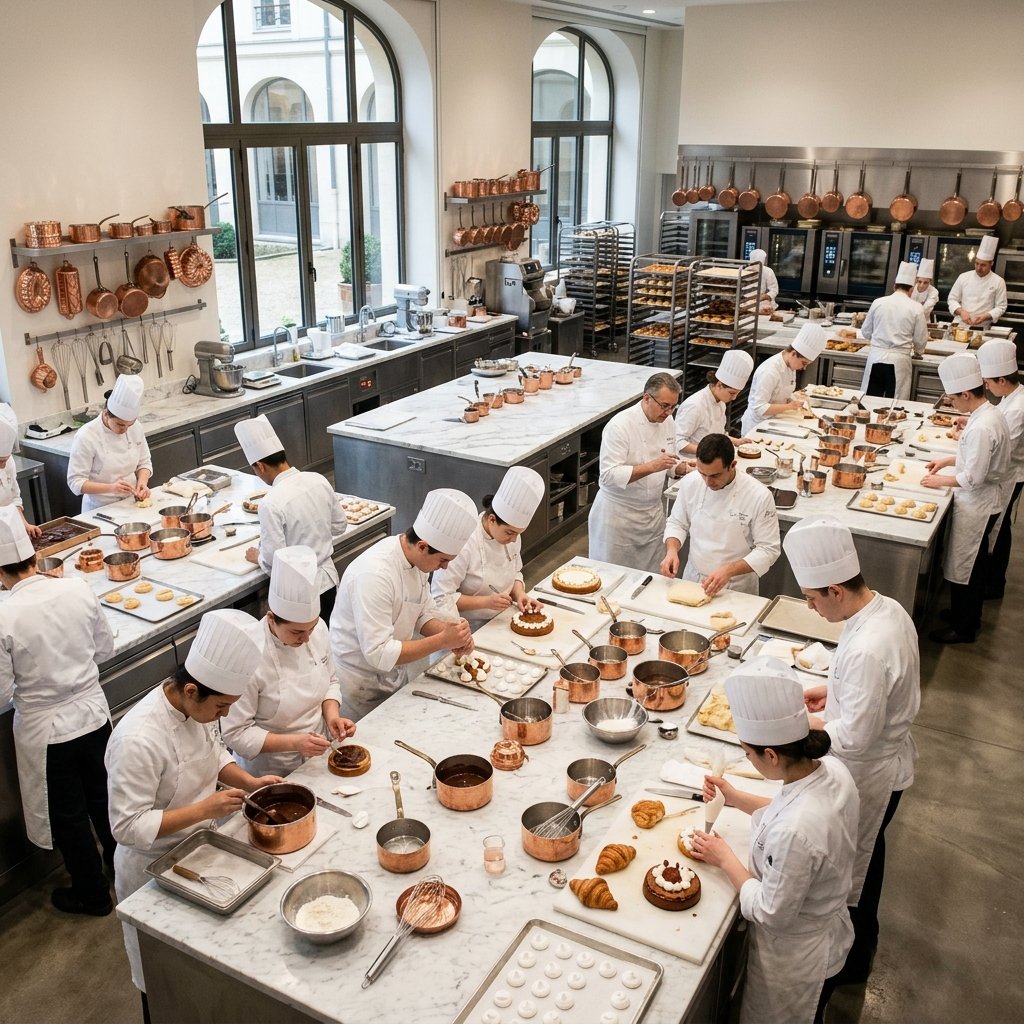
Top 10 Pastry Schools in the World — Detailed Rankings 2026
The following institutions represent the current global consensus on excellence in pastry arts education. Rankings are based on faculty credentials, industry placement, curriculum depth, alumni recognition, and programme accreditation. Fees are for 2025–26 academic year where available.
Le Cordon Bleu Paris
The world's most recognised culinary institution, founded in 1895. The Pâtisserie Certificate (3 months) and the Grand Diplôme (9 months, combining cuisine and pastry) remain the most globally prestigious credentials in the field. Faculty includes MOF (Meilleur Ouvrier de France) holders and alumni of three-Michelin-star kitchens. Class sizes are small and the Paris environment is genuinely irreplaceable for developing palate and aesthetic sensibility.
Tuition: €8,500–€22,000 · Total with living: ₹35–50LCulinary Institute of America (CIA)
America's foremost culinary institution, founded in 1946. The Baking & Pastry Arts AOS (Associate degree, 21 months) and the BPS (Bachelor of Professional Studies, 38 months) are industry benchmarks in the US. CIA's industry placement network is unmatched in North America — a genuine advantage for students targeting US hospitality careers. Faculty are working professionals with Michelin and James Beard credentials.
Tuition: $35,000–$100,000+ · Total: ₹40–80LInstitute of Culinary Education (ICE)
New York City's premier culinary school and consistently ranked among the world's best. The Pastry & Baking Arts diploma (7 months, 630+ hours) provides extraordinarily intensive hands-on training. ICE's New York location means constant exposure to the world's most competitive food city. Strong alumni network in US restaurant, hotel, and food media sectors. Also offers a campus in Los Angeles.
Tuition: $38,000–$42,000 · Total: ₹40–55LFERRANDI Paris
Often called "the Harvard of gastronomy," FERRANDI is the professional school of the Paris Île-de-France Chamber of Commerce and Industry. Unlike Le Cordon Bleu (which caters to international students and hobbyists), FERRANDI trains working professionals and future chefs for France's Michelin ecosystem. The Pastry Arts Professional programme is genuinely rigorous — and conducted primarily in French, which is a meaningful barrier for non-French speakers.
Tuition: €8,000–€18,000 · Total: ₹30–45LÉcole Ducasse
Alain Ducasse's professional culinary school, launched in 2012, has rapidly become one of the world's most respected training institutions. The Pastry Arts Essentials (2 weeks), Professional Pastry Arts (6 weeks), and Advanced Pastry (4 weeks) short programmes offer high-intensity professional training for experienced practitioners. The school's direct industry connection to Ducasse's 25 Michelin stars makes every session a direct window into world-class kitchen practice.
Tuition: €3,500–€15,000 · Total: ₹20–35LHofmann School of Gastronomy
Barcelona's Hofmann School has built a global reputation for pastry arts training, particularly in chocolate work, sugar art, and modern Spanish-influenced dessert techniques. The 9-month Professional Pastry Programme is conducted in Spanish and English and attracts students from across Europe and the Americas. The school's restaurant, Hofmann, holds a Michelin star — students work in a live professional environment from day one.
Tuition: €12,000–€16,000 · Total: ₹22–35LInstitut Paul Bocuse
Named for the legendary Paul Bocuse, this institution near Lyon offers degree-level hospitality and culinary education, including a Bachelor in Culinary Arts with strong pastry components. The Lyon culinary tradition — arguably the deepest in France — permeates every programme. More academically structured than Le Cordon Bleu or École Ducasse, Institut Paul Bocuse suits students who want a full degree qualification alongside professional training.
Tuition: €14,000–€20,000/yr · Total: ₹35–55LÉcole Hôtelière de Lausanne (EHL)
Switzerland's premier hospitality management school includes strong pastry and baking arts components within its world-ranked hospitality degree. EHL is less a dedicated pastry school and more a global hospitality education institution — but its pastry curriculum, Swiss chocolate and confectionery tradition, and extraordinary industry placement network make it a serious option for students targeting luxury hotel careers globally.
Tuition: CHF 30,000–40,000/yr · Total: ₹50–75LLe Cordon Bleu London
The London campus of Le Cordon Bleu offers identical curriculum prestige to Paris at a slightly different price point (GBP rather than EUR). The primary advantage for Indian students is English as the primary teaching language, a more straightforward student visa process, and proximity to the UK's extraordinarily competitive restaurant and patisserie market. The Pâtisserie Certificate (3 months) and Diplôme de Pâtisserie (6 months) are the most popular programmes.
Tuition: £11,000–£20,000 · Total: ₹35–55LInternational Culinary Center (ICC)
Originally Jacques Pépin's culinary school, ICC (now operating under CIA's umbrella) offers a range of professional pastry programmes with strong flexibility, including hybrid and online components. ICC's pastry faculty includes several James Beard-recognised chefs and its New York network is among the strongest in US food media and restaurant culture. An accessible entry point for students who want serious US culinary credentials at a somewhat lower investment.
Tuition: $25,000–$38,000 · Total: ₹30–50LFull Comparison Table: World's Top 10 Pastry Schools
| School | Location | Programme Length | Tuition (approx.) | Teaching Language | Speciality |
|---|---|---|---|---|---|
| Le Cordon Bleu Paris Most Prestigious | Paris, France | 3–9 months | €8,500–€22,000 | French + English | Classic French technique |
| CIA Hyde Park | NY, USA | 21 months (AOS) | $35,000–$55,000 | English | Industry placement (USA) |
| ICE New York | NY, USA | 7 months | $38,000–$42,000 | English | Intensive NYC immersion |
| FERRANDI Paris | Paris, France | 6–12 months | €8,000–€18,000 | French (primarily) | Professional French kitchen |
| École Ducasse | Paris, France | 2–6 weeks (intensive) | €3,500–€15,000 | French + English | Advanced professional skills |
| Hofmann Barcelona | Barcelona, Spain | 9 months | €12,000–€16,000 | Spanish + English | Modern dessert & chocolate |
| Institut Paul Bocuse | Écully, France | 3 years (degree) | €14,000–€20,000/yr | French + English | Full culinary arts degree |
| EHL Lausanne | Lausanne, Switzerland | 3–4 years (degree) | CHF 30,000–40,000/yr | English | Luxury hospitality career |
| Le Cordon Bleu London | London, UK | 3–6 months | £11,000–£20,000 | English | Classic French, English medium |
| ICC New York | NY, USA | 6–9 months | $25,000–$38,000 | English | Flexible; food media network |
| Truffle Nation Online Best for India | India (Online) | 6 weeks | ₹35,000 + GST | English | Professional + eggless + business |
What Actually Makes a Pastry School "World-Class" — 5 Real Criteria
Marketing language around culinary schools is notoriously unreliable. "World-class faculty," "industry connections," and "state-of-the-art facilities" appear in the brochure of virtually every cooking school from Paris to Patna. Here are the five criteria that actually differentiate elite institutions from aspirational ones:
Faculty Credentials That Are Verifiable and Current
The difference between a world-class school and an ordinary one often comes down to who is actually teaching. MOF (Meilleur Ouvrier de France) holders, James Beard Award recipients, Michelin-starred kitchen alumni — these credentials mean something because they're independently verifiable and scarce. Ask specifically: who are the faculty members teaching your programme, and what are their current professional credentials? Not what they did 20 years ago.
Curriculum Depth: Technique vs. Recipe Collection
A professional pastry curriculum teaches the science and logic behind each technique so students can troubleshoot, adapt, and innovate. A mediocre curriculum teaches recipes. The difference becomes obvious in the kitchen — a recipe-trained baker is helpless when something goes wrong; a technique-trained baker understands why it went wrong and how to fix it. Elite schools universally emphasise the former.
Industry Integration: Internships, Placements, and Live Service
The best schools don't just teach — they connect. CIA's industry placement rate, FERRANDI's partnerships with French hospitality groups, Hofmann's live Michelin-starred restaurant — these are not peripheral benefits but core components of the education. Schools that offer no pathway into the industry are, at best, training grounds with a premium price tag.
Alumni Network Quality and Geographic Reach
The value of a culinary school network is not the number of alumni but the quality of access it provides. Le Cordon Bleu's 130-year alumni network spans every significant culinary market on earth. CIA's alumni include the heads of multiple US hotel groups and restaurant empires. FERRANDI graduates populate the leadership of French hospitality. Networks of this calibre are genuinely career-transforming — in the right market.
Physical Environment and Ingredient Quality
This is underrated. Learning to temper Valrhona chocolate in a climate-controlled professional kitchen in Paris is a materially different experience from learning the same technique at home. The sensory environment — access to the finest ingredients, professional-grade equipment, the pressure of working alongside peers from 30 countries — accelerates skill development in ways that online learning cannot fully replicate. It is a genuine advantage of the top international schools, and a real part of the value proposition.
The most honest summary: international schools offer an experience premium that is real and valuable. The question for Indian students is whether the experience premium is worth the financial premium — typically ₹35–50 lakhs — relative to high-quality training available at a fraction of the cost, combined with the same systematic self-directed practice.
Ready to master professional baking from home?
The Full Cost Reality: What International Pastry School Actually Costs Indian Students
Let's do the math that most school websites deliberately obscure. Tuition is only the first line item. Here is a realistic total cost breakdown for an Indian student completing a 9-month programme at Le Cordon Bleu Paris in 2026:
| Cost Category | Estimated Amount (INR) | Notes |
|---|---|---|
| Tuition (Grand Diplôme, 9 months) | ₹19,00,000–₹21,00,000 | €22,000 at current exchange rates |
| Application + registration fees | ₹35,000–₹70,000 | Non-refundable |
| Student visa (Schengen long-stay) | ₹15,000–₹30,000 | VFS fees + appointment + documentation |
| Return flights (Delhi–Paris) | ₹75,000–₹1,20,000 | Economy, booked 3 months in advance |
| Accommodation (Paris, 9 months) | ₹10,00,000–₹15,00,000 | €1,100–€1,700/month for a small studio or shared flat |
| Food and daily living | ₹3,50,000–₹5,00,000 | €400–€550/month |
| Health insurance (mandatory) | ₹70,000–₹1,20,000 | International student health cover |
| Books, uniforms, equipment, tools | ₹80,000–₹1,40,000 | Required by most professional programmes |
| Travel within Europe (cultural learning) | ₹1,00,000–₹2,00,000 | Optional but practically unavoidable |
| Total Realistic Estimate | ₹36,00,000–₹47,00,000 | For 9 months, Le Cordon Bleu Paris |
For the CIA in New York or ICE in the US, substitute USD costs. A 21-month AOS at CIA can realistically cost ₹60–80 lakhs all-in for an Indian student when you account for the significantly higher US cost of living and the extended programme length.
The Hidden Costs Nobody Discusses
Beyond the direct financial cost, there are opportunity costs that rarely appear in any calculation. A 9-month programme abroad means 9 months of not building your Indian customer base, not refining your recipes for Indian ingredient availability, and not networking with the Indian food industry contacts that will actually determine your career in India. The non-monetary costs are real and significant.
A significant proportion of Indian students fund international culinary education through education loans at 9–13% interest. A ₹40 lakh loan at 11% over 7 years means EMIs of approximately ₹70,000–₹80,000/month. For a pastry chef starting at ₹30,000–₹50,000/month in India, this is a debt burden that can take a decade to clear — assuming continuous employment in the field, which is far from guaranteed.
What Indian Students Must Know Before Choosing an International Programme
The decision to study pastry internationally is not simply a question of ambition or aspiration — it involves a series of practical realities that are specific to Indian students. Here is the full picture:
Visa Requirements and Success Rates
A student visa for France (Schengen long-stay, Type D), the US (F-1), or the UK (Student Visa) requires significantly more than just an acceptance letter. French student visa applications require: proof of enrolment, proof of financial means (typically €615–€700 per month of stay plus full tuition covered), health insurance coverage, accommodation confirmation, and a clean travel history. Processing times range from 4–12 weeks, and rejections do occur — primarily on financial grounds. The UK Student Visa requires a Confirmation of Acceptance for Studies (CAS) from the institution and proof of English language proficiency (IELTS 5.5–6.5 typically required). The US F-1 visa for culinary students requires an I-20 from a SEVP-certified institution, a SEVIS fee payment, and a visa interview that has higher refusal rates for first-time applicants from India than many other nationalities.
Language Barriers at French Schools
FERRANDI Paris conducts most professional programmes in French. Even Le Cordon Bleu Paris, which markets heavily to international students and offers English translation during sessions, operates in a French-speaking city where daily life requires functional French for grocery shopping, accommodation negotiation, banking, and social integration. Students who arrive without at least A2-level French face significant additional stress that detracts from learning focus. If you're targeting a French school, begin French language study at least 6–12 months before programme start.
Dietary Restrictions and Eggless Adaptation
Here is a challenge that international schools virtually never address: for Indian pastry students who come from vegetarian families or who plan to serve a largely vegetarian market in India, the international curriculum is almost entirely egg-dependent. Le Cordon Bleu's pâtisserie curriculum uses eggs in approximately 80% of preparations. There is no systematic eggless adaptation provided — students must figure out their own adaptations independently, after returning home, to serve the Indian market effectively.
This is not a reason to avoid international training, but it is a genuine gap that students should plan for. The skills and techniques are real and valuable; the market adaptation work is yours to do after.
The Return-to-India Transition
Students who return to India after international pastry training frequently report a challenging adjustment period. European butter, European chocolate, European flour — the precise ingredients used in international training — are not easily replicated in India at affordable prices. The ₹800/kg Valrhona chocolate used in a Paris training kitchen is not the same as the most widely available Indian cooking chocolate. Adapting international techniques to Indian ingredient realities is a significant, underappreciated skill set that requires months of post-programme experimentation.
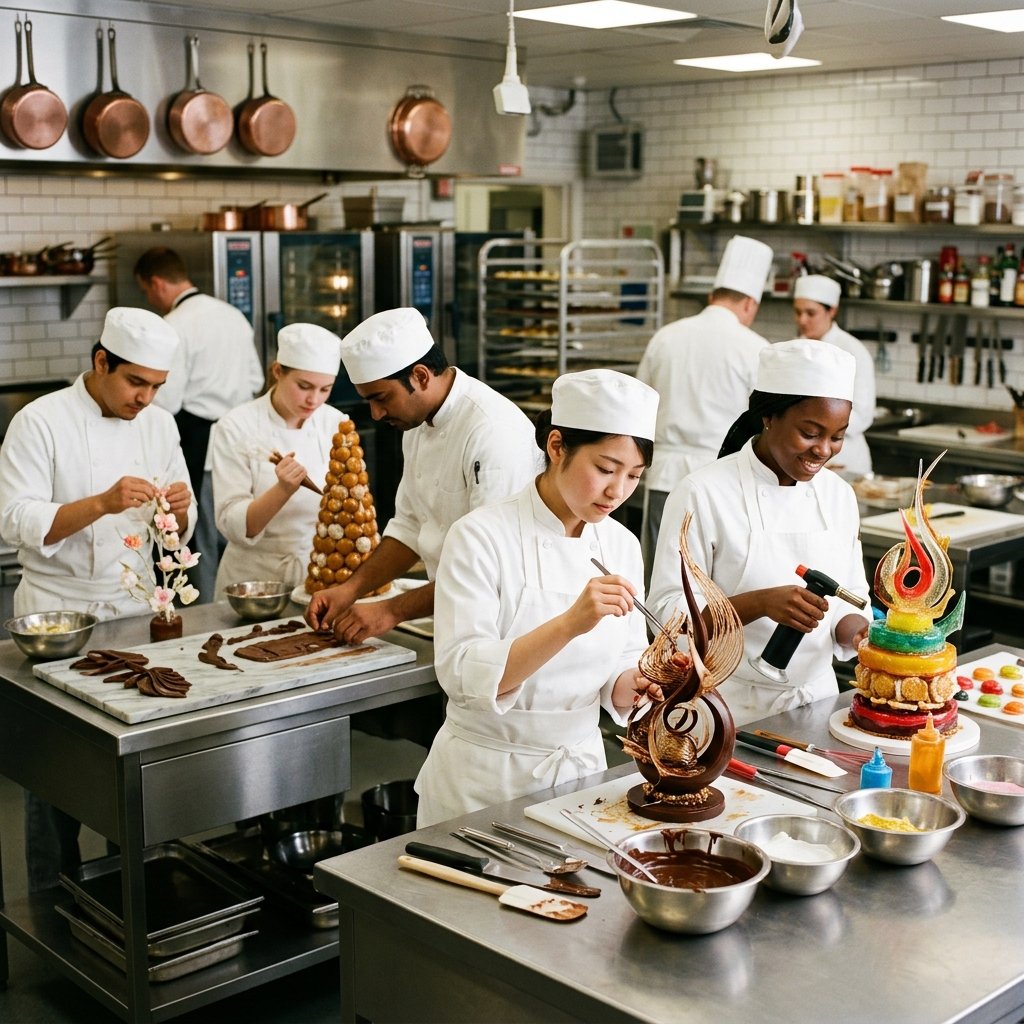
Indian Qualification vs. International — What Actually Matters for a Career in India
Let's address the question directly, because it's the one most guides avoid: does an international pastry certificate from Le Cordon Bleu or CIA meaningfully improve your career outcomes in India compared to excellent Indian training?
The honest answer: for most Indian career paths, no — with specific exceptions.
Where International Training Genuinely Adds Value in India
- Five-star international hotel groups (Oberoi, Taj, Four Seasons, Marriott) frequently place candidates with international culinary credentials at a slight advantage for head pastry chef or CDT (Chef de Tournant) positions — but the differential narrows rapidly once you have 2–3 years of verifiable Indian kitchen experience.
- Premium patisserie brand positioning — if you're launching a premium café or patisserie brand in a Tier-1 Indian city, an international credential can be used as a brand differentiator in marketing. Some consumers respond to "Le Cordon Bleu trained" as a quality signal.
- Teaching at premium culinary institutes — Indian culinary schools increasingly value international training credentials for faculty recruitment. If you intend to teach, an international credential carries weight.
- Working abroad long-term — if your actual goal is to build a career in France, the UK, Australia, or the UAE, an international credential from a local institution is not optional — it's essential.
Where International Training Offers Marginal Additional Value
- Home bakery businesses — your Instagram presence, product quality, customer service, and pricing strategy determine success far more than your certificate. Customers ordering from home bakers are buying the product, not the credential.
- Mid-market café employment — most cafés in India at the ₹150–350 average-spend tier hire on portfolio and practical skill demonstration, not certificate provenance.
- Corporate catering and cloud kitchen roles — these roles are skill-and-reliability based. A strong practical portfolio from any credible training programme is sufficient.
India's best-earning pastry professionals — those running ₹50,000–₹2,00,000/month businesses or heading pastry kitchens at premium establishments — are distinguished almost exclusively by their skill, consistency, and business acumen. Among the top 100 home pastry business operators in India, you'll find training backgrounds ranging from Le Cordon Bleu to local institutes to self-taught practice with structured online guidance. The certificate is not the variable. The skill and the strategy are.
Ready to master professional baking from home?
World-Class Alternatives: Building Professional Pastry Skills from India
The framing of "international school vs. stay in India" is a false binary. The real question is: what combination of training, practice, and market positioning will give you the highest-quality skill development and the best career outcomes, at a cost you can sustain?
For the vast majority of Indian aspiring pastry professionals — including those with genuine ambitions for five-star hotel kitchens, premium patisserie businesses, or professional teaching careers — the optimal path does not require ₹40 lakhs abroad. It requires structured, serious training from credible instructors, combined with intensive self-directed practice, and a clear business or career strategy.
Tier 1: Premium Indian Offline Institutes
Lavonne Academy in Bengaluru, the Institute of Hotel Management (IHM) network, and BAKE Mumbai offer genuinely professional-grade pastry training at ₹1.5–3.5 lakhs for diploma programmes. The hands-on training is excellent, the faculty increasingly well-credentialed, and the network is directly relevant to Indian industry. For students who can relocate to a metro city and invest 3–12 months in full-time study, these are the strongest value options in the tier just below international programmes.
Tier 2: Live Online Professional Certification
The emergence of high-quality live online pastry programmes has created a genuinely new category — one that didn't exist five years ago in India. The key distinction is live instruction versus recorded video. A library of pre-recorded baking videos, however high-quality, cannot replicate the real-time feedback, question-answering, and technique correction that live sessions provide.
Truffle Nation's 6-week Live Online Pastry Chef Certification is the standout programme in this category. Built specifically for the Indian market — not adapted from a foreign curriculum — it addresses the realities that international schools ignore: Indian ingredient availability, eggless adaptations for the vegetarian market, and the business skills required to actually generate income from pastry expertise.
The programme covers professional pastry technique across 30 live Zoom sessions, with an India-specific curriculum that is 100% eggless by design. This is not a compromise — it's a genuine competitive advantage. A pastry professional in India who can execute high-quality eggless versions of French classics captures both the egg-eating and vegetarian markets simultaneously.
The business toolkit component — pricing formulas, FSSAI licensing guidance, food photography, and selling strategies for Indian platforms — reflects an understanding of what students actually need to convert skills into income. This is content that Le Cordon Bleu's curriculum will never cover because it's not designed for the Indian market.
Compare the total investment: INR 35,000 + GST for Truffle Nation's certification versus ₹40–50 lakhs for a comparable international programme. The skills gap between these two paths is real but dramatically narrower than the price gap. For students who follow structured practice after the programme, the skill outcomes are closer than most people expect.
For further context on how Indian professional certifications compare, read our detailed guides on online baking courses in India and the best baking classes in Delhi.
Tier 3: Self-Directed Practice with Structured Guidance
For students who have completed a foundational programme — either online or offline — and are ready to specialise, structured self-directed practice is the fastest path to the advanced skills that differentiate professionals. This means: deliberately practising specific techniques, sourcing quality ingredients (imported chocolate, cultured butter for lamination work), and building a portfolio that demonstrates your skill level directly.
The best practitioners of any craft combine formal training with substantial self-directed deliberate practice. Professional programmes give you the correct framework and prevent the bad habits that self-taught bakers typically develop. Practice after the programme builds the speed, consistency, and confidence that separate professionals from enthusiasts.
Start with a serious live online certification that teaches correct technique and India-specific applications. Practice systematically for 3–6 months. Consider a short-form intensive at a top Indian offline institute if you need hands-on refinement. Only pursue international training if your specific career goal (working abroad, premium Indian brand positioning, culinary teaching) generates returns that justify the ₹35–50 lakh investment. For most, they don't.
School Evaluation Criteria — What We Measured
Annual Tuition at Top Pastry Schools (Approximate)
Frequently Asked Questions
Conclusion: The Right School Is the One That Serves Your Actual Career
The world's best pastry schools — Le Cordon Bleu, CIA, ICE, FERRANDI, École Ducasse — are genuinely extraordinary institutions that produce genuinely skilled professionals. The craftsmanship, the prestige, the network, the experience of learning in Paris or New York — none of this is exaggerated. It is real, and it has value.
The question that matters for an Indian student is simpler and more personal: does a ₹35–50 lakh investment in an international programme generate career outcomes that justify that cost, relative to alternative paths available right now? For students targeting international careers, premium brand positioning in India, or professional teaching roles, the answer can be yes. For the majority of students who want to build a successful home bakery, café, or hotel pastry career in India, the answer is almost always no — not because the international schools are overrated, but because the Indian market rewards skill and strategy over certificate provenance.
The most valuable thing any aspiring pastry professional can do — regardless of training budget — is build genuine, demonstrable skill through structured learning and systematic practice. That foundation is available to you at any price point. The question is which training programme gives you the most rigorous foundation for your specific career path and market.
If you're weighing your options and want to understand what professional live online training looks like at a fraction of international costs, a free call with Truffle Nation's course advisors is the most efficient next step. No commitment required — just an honest conversation about where you want to go and what path gets you there.
Ready to master professional baking from home?
Also read: How to Become a Pastry Chef in India: The Complete 2026 Guide · Best Online Baking Courses in India · Best Baking Classes in Delhi 2026