If you have been searching for the best online baking course in India, you have probably noticed something frustrating: every review you find is either a thinly disguised advertisement or a generic list with no real analysis. "Top 10 baking courses" articles that rank platforms based on Instagram follower counts tell you nothing about what you will actually learn, how the instruction is delivered, or whether the certificate will help you land clients.
This review is different. We spent three months researching the most popular online baking courses available to Indian students in 2026. We examined curricula, spoke with graduates, compared pricing structures, and evaluated what each program actually delivers versus what it promises on its sales page. We are including Truffle Nation in this comparison because we believe transparency serves everyone — and we are confident enough in our program to put it side by side with every competitor.
What follows is the most detailed online baking course review and comparison available for the Indian market. Whether you are a complete beginner exploring baking as a career, a homemaker looking to start a home bakery business, or a working professional considering a career switch — this guide will help you invest your money and time wisely.
Want to learn professional baking live from home?
1. Why Choosing the Right Online Baking Course Matters
An online baking course is not like buying a book or watching YouTube tutorials. It is a significant investment of money (typically ₹15,000-₹30,000 for a quality program), time (4-8 weeks of committed learning), and opportunity cost (the recipes you learn and business skills you develop — or fail to develop — directly shape your earning potential for years).
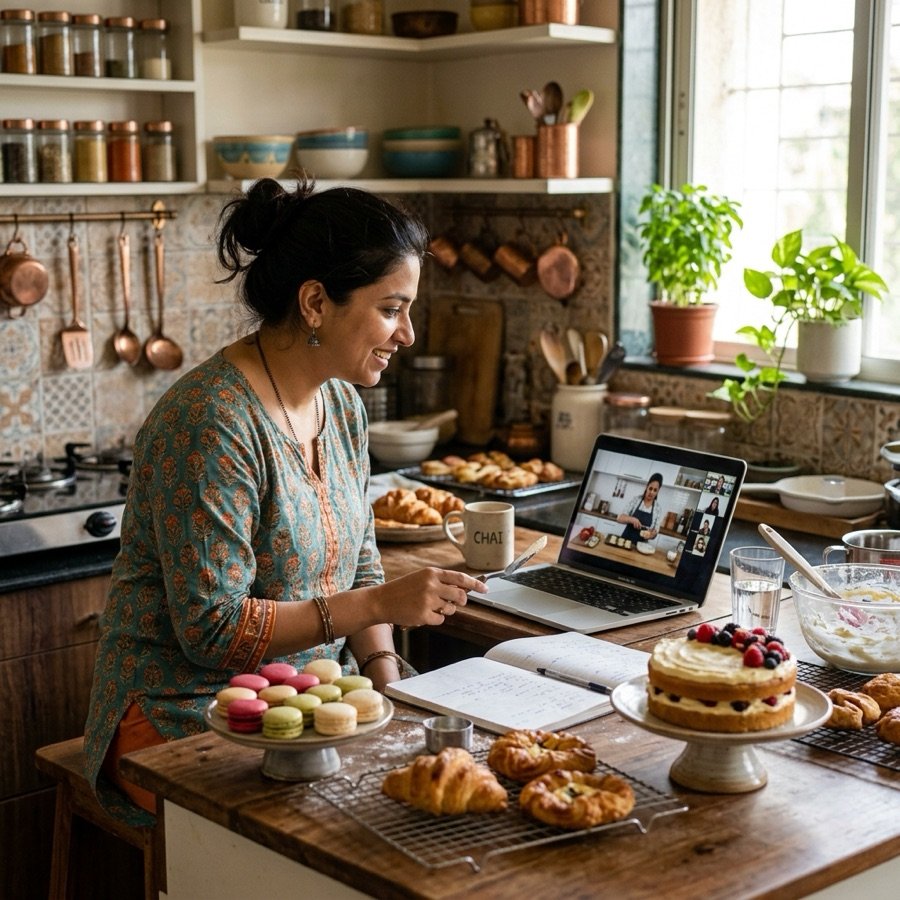
The wrong course does not just waste your tuition fee. It wastes months of your life learning techniques that do not translate to commercial baking, recipes that customers do not want, and business approaches that do not work in the Indian market. We have spoken to dozens of bakers who completed one course, realised it taught them nothing commercially viable, and then had to invest in a second course to actually start earning. That is ₹30,000-₹50,000 and 4-6 months lost.
The Real Cost of a Bad Course Choice
- Financial cost: Course fee (₹5,000-₹50,000) + ingredients for practice during course (₹3,000-₹8,000) + equipment purchased for course assignments (₹2,000-₹5,000). A bad course can cost ₹10,000-₹60,000 in total when you account for all associated spending.
- Time cost: 4-12 weeks of committed learning time. If the course does not prepare you for commercial baking, that is 1-3 months you could have spent learning effectively elsewhere.
- Confidence cost: This is the most underestimated impact. Graduates of poor courses often believe they are not good enough to start a business, when in reality their course simply failed to teach them properly. We have seen talented bakers delay their business launch by 6-12 months because a bad course destroyed their confidence.
- Career delay: Every month you spend on the wrong course is a month you are not earning from your bakery business. At ₹30,000-₹50,000 monthly profit potential for a home bakery, a 3-month delay in your career start costs ₹90,000-₹1,50,000 in lost income. This makes the course fee itself the smallest part of the total cost equation.
The right online baking course is not the cheapest one — it is the one that gets you to your first paying customer fastest. A ₹25,000 course that includes business training and gets you earning within 2 months has a better ROI than a ₹5,000 course that teaches you recipes you cannot sell. Think of it as a business investment, not a tuition expense. For a detailed analysis of what baking courses cost and what you should expect at each price point, see our complete baking course fees guide.
2. What to Evaluate: The 7 Critical Criteria
Before reviewing individual courses, let us establish the framework we used to evaluate them. These seven criteria separate courses that genuinely prepare you for a baking career from those that are essentially glorified YouTube playlists behind a paywall.
Live vs Pre-Recorded Format
This is the single most important differentiator. Live instruction (via Zoom or similar platforms) means you bake in real-time alongside the instructor, ask questions when you are stuck, get immediate feedback on your technique, and interact with fellow students. Pre-recorded courses are video libraries you watch passively. The completion rate for pre-recorded online courses across all industries is 15-25%. For live courses, it is 75-85%. The format determines whether you actually finish the course and develop real skills. Some programs advertise as "live" but are actually pre-recorded sessions with a weekly Q&A — that is not the same thing.
Curriculum Depth and Relevance
Count the number of recipes and techniques taught, but more importantly evaluate whether those recipes are commercially viable in the Indian market. A course teaching 50 French patisserie recipes using obscure imported ingredients is less useful for an Indian baker than one teaching 35 recipes that Indian customers actually buy — eggless cakes, brownies, cookies, Indian fusion desserts, and trending products like dessert jars and cake pops. The curriculum should also cover fundamental techniques (creaming, folding, tempering, ganache, buttercream) not just recipes, so you can create your own products.
Instructor Credentials
Who is actually teaching? A trained pastry chef with 10+ years of professional experience and industry credentials delivers a fundamentally different learning experience than a home baker who became popular on Instagram. Both can be good teachers, but professional credentials matter for technique accuracy, troubleshooting ability, and the depth of knowledge they can share. Look for instructors who have worked in professional kitchens, hold recognised culinary qualifications, or have a demonstrable track record of training successful bakers.
Business Training Inclusion
This is where most online baking classes fail completely. They teach you to bake but not to earn. A course that does not include pricing strategy, cost calculation, FSSAI registration guidance, packaging standards, Instagram marketing for bakers, and basic business planning leaves you as a skilled hobbyist, not a professional. If you plan to earn from baking, business training is non-negotiable. The best courses dedicate 15-20% of their curriculum to business skills.
Certificate Value
Not all certificates are equal. A certificate from a recognised culinary institution carries weight with clients and employers. A PDF certificate from an unaccredited online platform has minimal professional value. Evaluate whether the issuing institution is recognised, whether the certificate specifies the skills and hours completed, and whether it carries any industry accreditation. For home bakery businesses, a good certificate serves as a trust signal — customers feel more confident ordering from a "certified pastry chef" than a self-taught baker.
Batch Size
This directly determines how much personal attention you receive. A course capped at 50 students can still allow the instructor to check progress, answer individual questions, and provide personalised feedback. A course with 200+ students per batch is essentially a webinar — you are watching a demonstration, not receiving instruction. For interactive online learning, look for a clearly stated cap of 50 students or fewer.
Post-Course Support
What happens after the course ends? The best programs offer recording access for revision (60-90 days minimum), alumni communities for ongoing support, instructor access for troubleshooting, and refresher sessions. Programs that cut you off the moment the course ends leave you without support during the most critical period — when you are actually starting to bake commercially and encountering real-world problems the course could not anticipate.
When evaluating any online baking course in India, score it on each of the 7 criteria above on a scale of 1-5. Any course scoring below 3 on more than two criteria is not worth your investment. Any course scoring 5 on format (live), business training, and batch size is likely worth the premium it charges. For a broader guide on evaluating baking programs, read our comprehensive baking courses guide.
3. Detailed Reviews: 8 Online Baking Courses in India
We evaluated every major online baking course available to Indian students in 2026. Here are detailed reviews of the 8 most popular and widely advertised programs, ordered by our overall assessment. For each course, we evaluate the format, curriculum, instructor quality, business training, certificate, batch size, and post-course support.
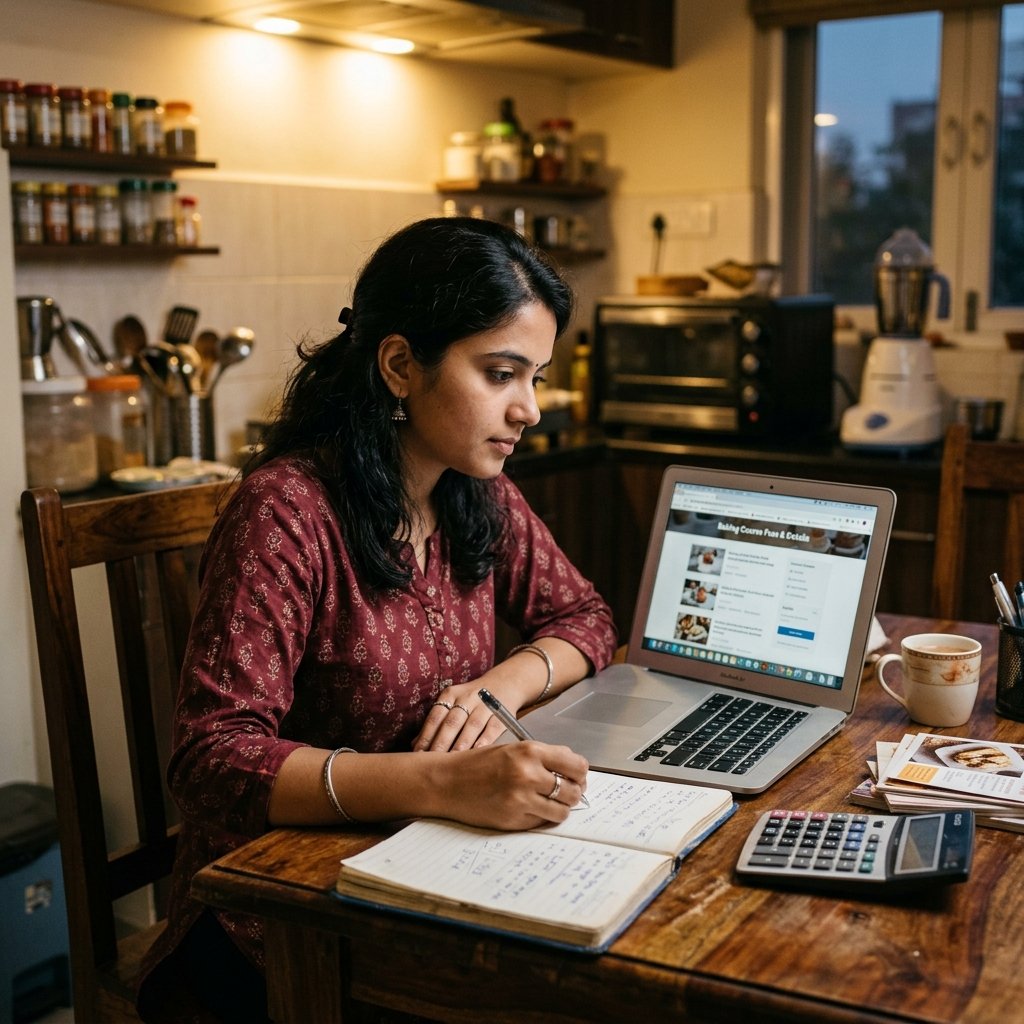
3.1 Truffle Nation Online — 6-Week Live Pastry Chef Certification
100% Live Zoom | 30 Sessions
Every session is conducted live on Zoom. Students bake in real-time alongside the instructor. No pre-recorded content sold as "live." Sessions are recorded for 90-day revision access, but the primary delivery is always live and interactive.
50 Students Maximum
Strictly capped at 50 students per batch. This keeps the sessions interactive while allowing instructors to answer individual doubts and provide feedback on technique and presentation.
Curriculum: 50+ recipes covering cakes (layered, drip, theme, mirror glaze), brownies, cookies, breads, chocolates, truffles, pastries, dessert jars, cheesecakes, and Indian fusion desserts. Entire curriculum is 100% eggless — designed specifically for the Indian market where over 40% of customers prefer eggless products. Includes dedicated modules on fondant work, buttercream techniques, ganache mastery, and advanced decoration.
Business Training: Full business module covering product costing and pricing strategy, FSSAI registration walkthrough, Instagram marketing for bakers, packaging and presentation standards, order management systems, and a complete bakery business launch toolkit. This is not a 30-minute add-on — it is a substantial component of the program.
Instructor Credentials: Professional pastry chef-led instruction with industry experience in hotel and bakery operations. Instructors hold formal culinary qualifications and have trained 2,400+ students who have gone on to launch bakery businesses across India.
Certificate: Professional certificate upon completion specifying skills, hours, and competencies. Recognised within the Indian baking industry and useful as a trust signal for home bakery customers.
Post-Course Support: 90-day recording access, alumni WhatsApp community, ongoing troubleshooting support from instructors.
Best overall value for Indian students. The combination of 100% live instruction, batches capped at 50, comprehensive eggless curriculum, and dedicated business training makes this the most career-ready program available at this price point. The 100% eggless focus is a genuine differentiator — no other program addresses the Indian market's dietary preferences this thoroughly. Ideal for beginners and career-changers who want to both learn professional baking and launch a business.
3.2 ICCA (International Centre for Culinary Arts) — Online Patisserie Program
Format: Hybrid — pre-recorded video modules with scheduled live Q&A sessions (typically 1-2 per week). The core instruction is video-based; live sessions are supplementary, not the primary teaching method.
Curriculum: Comprehensive international patisserie curriculum covering French, Italian, and contemporary techniques. 40+ recipes with strong emphasis on classical technique. Heavy focus on egg-based European patisserie. Limited eggless coverage. Excellent for technique fundamentals but requires adaptation for the Indian market.
Batch Size: 50-80 students per cohort. Live Q&A sessions can feel crowded; individual attention is limited.
Business Training: Minimal. Focus is on culinary technique, not commercial application. No pricing, costing, or marketing modules.
Certificate: Strong institutional recognition. ICCA brand carries weight in the hospitality industry, which is valuable if you are targeting hotel or restaurant employment rather than home bakery entrepreneurship.
Post-Course Support: Recording access for the duration of the program. Limited post-course engagement.
Best for those targeting hotel or restaurant careers. The ICCA name carries institutional weight that matters in the hospitality industry. However, the predominantly pre-recorded format, large batch sizes, egg-heavy curriculum, and absence of business training make it less suitable for aspiring home bakers or entrepreneurs. You will learn excellent technique but will need to figure out the business side on your own.
3.3 Coursera / edX — Baking and Pastry Courses (Le Cordon Bleu, CIA partnerships)
Format: 100% pre-recorded. Self-paced video lectures from partner institutions. No live instruction whatsoever. No real-time interaction with instructors or peers.
Curriculum: Varies by course. Le Cordon Bleu's Coursera program covers fundamental baking science and technique. Content quality is high but entirely Western-oriented — recipes assume ingredients and equipment commonly available in the US/Europe. Minimal relevance to Indian market preferences, ingredients, or customer expectations.
Batch Size: Unlimited. These are MOOC (Massive Open Online Course) platforms — thousands of students enrol simultaneously with zero individual attention.
Business Training: None. These are pure culinary education programs.
Certificate: Coursera certificates have limited professional value in the Indian baking industry. The Le Cordon Bleu name has prestige, but a Coursera certificate is not equivalent to a Le Cordon Bleu diploma.
Post-Course Support: Forum-based community support. No instructor interaction.
Good for theory and baking science, not for career readiness. These courses are excellent supplements to a primary baking education — they deepen your understanding of why techniques work. But as standalone programs for someone wanting to start an Indian bakery business, they fall short on every practical dimension: no live instruction, no Indian market relevance, no business training, and certificates with limited local recognition.
3.4 Swad Culinary Academy — Online Baking Certification
Format: Live Zoom sessions, conducted in Hindi and English. Sessions are 2-3 hours each, held on weekends. Total duration 8-10 weeks.
Curriculum: 35-40 recipes with a mix of eggless and egg-based options. Good coverage of Indian favourites — eggless cakes, cookies, brownies, and basic chocolate work. Curriculum is more beginner-friendly than advanced. Limited coverage of trending products like dessert jars, mirror glaze, or artisan bread.
Batch Size: 40-60 students per batch. Larger than ideal for individual attention but still manageable for live sessions.
Business Training: Basic business module included covering pricing fundamentals and FSSAI registration. Not as comprehensive as a dedicated business toolkit but better than most competitors.
Certificate: Academy certificate with reasonable local recognition. Not internationally accredited.
Post-Course Support: 60-day recording access. Alumni group for networking.
Solid mid-range option for Hindi-speaking beginners. The bilingual instruction is a genuine advantage for students more comfortable in Hindi. Curriculum is adequate for starting a basic home bakery. Main limitations are larger batch size, narrower recipe range, and less comprehensive business training compared to top-tier options.
3.5 Academy of Pastry & Culinary Arts — Online Diploma
Format: Hybrid model — pre-recorded instructional videos with periodic live demonstrations. Core learning is self-paced with scheduled live check-ins every 1-2 weeks. Duration 3-6 months depending on pace.
Curriculum: Extensive — 60+ recipes covering baking, patisserie, chocolate work, and sugar craft. One of the most comprehensive curricula available. Heavy emphasis on technique and presentation. Mix of egg-based and eggless recipes with international orientation.
Batch Size: 80-120 students per cohort. Live sessions are primarily demonstrations with limited Q&A time.
Business Training: Basic entrepreneurship module included but not the program's strength. Focus remains on culinary skills.
Certificate: Diploma certificate with good institutional recognition. One of the more established names in Indian culinary education.
Post-Course Support: Extended video access. Placement assistance for select programs.
Best for those wanting a diploma-level qualification with maximum recipe coverage. The extensive curriculum and institutional reputation are genuine strengths. However, the predominantly pre-recorded format, very large batch sizes, and limited individual attention make skill development slower than in live-instruction programs. The longer duration (3-6 months) also means a longer gap before you start earning. Good for those who have the time and want credentials over speed-to-market.
3.6 Udemy / Skillshare — Baking Courses
Format: 100% pre-recorded. Self-paced video courses. No live component. No cohort-based learning. You are entirely on your own.
Curriculum: Highly variable. Some individual courses are excellent (particularly those by professional pastry chefs), but most are hobbyist-level content. No quality control or standardisation. You may need to purchase 4-5 separate courses to cover what a single structured program teaches. Recipes are overwhelmingly Western-oriented.
Batch Size: Unlimited. No instructor interaction.
Business Training: Separate courses exist for food business, but there is no integrated curriculum combining baking skills with business skills.
Certificate: Udemy certificates carry no professional recognition. They are completion certificates only.
Post-Course Support: Course Q&A section (responses vary wildly). No structured support.
Acceptable only as a supplementary resource, not a primary learning path. At ₹500-₹2,000 per course during sales, Udemy courses can supplement your primary training. But as a standalone education for someone wanting to bake professionally, they are inadequate. The completion rate for Udemy courses is under 10%. No live instruction, no accountability, no Indian market relevance, and no meaningful certificate. You get what you pay for.
3.7 Instagram-Based Baking Workshops (Various)
Format: Typically 1-3 day live workshops conducted over Zoom or Instagram Live. Short-form, intensive sessions focused on specific products (e.g., "Brownie Masterclass," "Cake Decoration Workshop"). Duration is 2-8 hours total.
Curriculum: Very narrow — 3-8 recipes per workshop focused on a single product category. Useful for learning specific techniques but does not provide a comprehensive baking education. Quality is entirely dependent on the individual instructor.
Batch Size: Varies wildly — from 20 to 500+ participants depending on the instructor's following. Many popular instructors run workshops with 200-300 students.
Business Training: Rarely included. Some instructors offer separate business workshops.
Certificate: PDF completion certificates with zero industry recognition.
Post-Course Support: Typically none beyond a shared WhatsApp group that goes inactive within weeks.
Good for learning a specific product quickly, inadequate for career preparation. Instagram workshops serve a purpose — if you want to learn one specific product (say, Turkish baklava or mirror glaze cakes), a focused 3-hour workshop from a skilled instructor can be excellent. But they are not a substitute for comprehensive training. Spending ₹15,000 across 5-6 workshops gives you scattered knowledge across products without the foundational technique, business training, or recognised certification that a structured professional baking course provides.
3.8 YouTube + Free Resources (Self-Taught Path)
Format: Entirely self-directed. You curate your own learning from YouTube channels, blogs, and free recipe sites. No structure, no accountability, no feedback.
Curriculum: Unlimited content available, but zero curation. You spend as much time searching for good content and resolving contradictory advice as you do actually learning. No structured progression from fundamentals to advanced techniques.
Batch Size: N/A — solo learning.
Business Training: Available in separate resources but not integrated with baking education.
Certificate: None.
Post-Course Support: YouTube comment sections and baking forums.
Not recommended as a primary learning path for career-oriented bakers. We know talented bakers who are largely self-taught. But they are the exception, and they typically spent 12-24 months reaching a skill level that structured courses achieve in 6-8 weeks. For hobby baking, free resources are fine. For career baking, the time cost of self-teaching makes it the most expensive option despite being "free." Without feedback on your technique, you develop bad habits that become harder to correct over time.
4. Head-to-Head Comparison: All 8 Courses
Here is the complete side-by-side comparison across every evaluation criterion. This table gives you the facts at a glance so you can make an informed decision based on what matters most to your situation.
| Course | Fees | Duration | Format | Recipes | Batch Size | Business Training | Certificate |
|---|---|---|---|---|---|---|---|
| Truffle Nation Online Top Pick | ₹25,000 | 6 weeks | 100% Live Zoom | 50+ | 50 | Comprehensive | Professional |
| ICCA Online | ₹35,000-₹50,000 | 8-12 weeks | Pre-recorded + Live Q&A | 40+ | 50-80 | Minimal | Strong institutional |
| Coursera (Le Cordon Bleu) | ₹3,000-₹8,000 | Self-paced (4-8 wks) | 100% Pre-recorded | 20-30 | Unlimited | None | Platform certificate |
| Swad Culinary Academy | ₹15,000-₹22,000 | 8-10 weeks | Live Zoom (weekends) | 35-40 | 40-60 | Basic | Academy certificate |
| Academy of Pastry & Culinary Arts | ₹30,000-₹45,000 | 3-6 months | Pre-recorded + Live demos | 60+ | 80-120 | Basic | Diploma |
| Udemy / Skillshare | ₹500-₹3,000/course | Self-paced | 100% Pre-recorded | 5-15/course | Unlimited | None | Completion only |
| Instagram Workshops | ₹1,500-₹5,000/workshop | 1-3 days | Live (variable quality) | 3-8/workshop | 20-500 | Rarely | PDF certificate |
| YouTube (Self-Taught) | Free | 12-24 months | Pre-recorded | Unlimited | N/A | Separate | None |
The "right" course depends on your priorities. If you want the strongest institutional brand name, ICCA or Academy of Pastry wins. If you want the cheapest option, Udemy or YouTube wins. But if your priority is career readiness — the fastest path from "I want to learn baking" to "I am earning from baking" — then the combination of live format, small batch, business training, and Indian-market-focused curriculum matters more than brand prestige or rock-bottom pricing. That is why we weight format, batch size, and business training most heavily in our evaluation.
Looking for the live, career-focused option?
5. Why Truffle Nation Stands Out: A Detailed Look
We are transparent about the fact that we operate Truffle Nation Online, so let us be equally transparent about why we believe our program delivers the best value for Indian baking students. Here are the five specific differentiators that we believe no other online baking course in India currently offers in combination.
5.1 The 100% Eggless Advantage
Every other course on this list teaches predominantly egg-based recipes, with eggless versions offered as modifications or add-ons. We do the opposite. Our entire 50+ recipe curriculum is built from the ground up as 100% eggless. Why does this matter?
- Market demand: Over 40% of Indian consumers prefer eggless baked goods for religious, dietary, or preference reasons. This is not a niche — it is nearly half the market.
- Price premium: Eggless products command a 15-20% price premium in the Indian market. A 1 kg eggless chocolate cake sells for ₹850-₹1,000 versus ₹700-₹800 for egg-based. Over 100 orders per month, that premium adds ₹15,000-₹20,000 to your monthly revenue.
- Broader customer base: An eggless bakery can serve everyone — vegetarians, Jains, those with egg allergies, and those who simply prefer eggless. An egg-based bakery excludes a large segment of the Indian market.
- Recipe integrity: When eggless is taught as a modification of egg-based recipes (replace egg with curd/flaxseed), results are inconsistent. When recipes are developed as eggless from scratch, they are optimised for texture, rise, and flavour without eggs. Our students consistently report that their eggless products are indistinguishable from — or better than — egg-based equivalents.
5.2 Live Instruction with Real Accountability
Every one of our 30 sessions is conducted live on Zoom. This is not "live" in the sense that a pre-recorded video is streamed at a scheduled time. Students bake in real-time alongside the instructor. The instructor can see students' work, provide immediate corrections, and answer questions as they arise. This mirrors the apprenticeship model that has trained pastry chefs for centuries — except you do not need to leave your home.
The accountability of live sessions is crucial. When you know you need to show up at a specific time with ingredients ready, you actually do it. When you can "watch later" at your convenience, you do not. Our completion rate is above 85% — compared to under 25% for pre-recorded course platforms.
5.3 Interactive Batches Capped at 50 Students
We cap every batch at 50 students. This keeps the program meaningfully more interactive than mass-market webinars with hundreds of attendees. With a defined 50-student cap, the instructor can:
- Check on each student's progress during practical sessions
- Answer every individual question within the session
- Provide personalised feedback on technique, presentation, and troubleshooting
- Learn each student's name, skill level, and goals — creating genuine mentorship
- Create a cohort community where students know and support each other
In a batch of 100-200 students, the instructor cannot possibly provide this level of attention. You become an anonymous viewer, not a student being actively taught. The learning experience degrades from education to entertainment.
5.4 Business Toolkit — Not Just Recipes
Our business training module is not a hastily added afterthought. It includes a complete costing and pricing spreadsheet (customisable for your city and products), FSSAI registration step-by-step walkthrough, Instagram content calendar and marketing strategy specifically designed for home bakers, packaging sourcing guide with vendor contacts, order management templates, and a bakery business launch checklist that takes you from "course graduate" to "taking my first paid order" in the shortest possible time.
This is why over 60% of our graduates start earning within 3 months of completing the course. The business toolkit removes the "I know how to bake but I do not know how to start" barrier that stops most course graduates from ever launching.
5.5 Certificate with Professional Weight
Our professional certificate specifies the skills acquired, techniques mastered, hours of training completed, and competencies achieved. It is not a generic "certificate of completion" — it is a professional credential that our graduates use on their business profiles, Instagram bios, and marketing materials. For home bakers, displaying a professional certification builds immediate customer trust and justifies premium pricing.
6. Red Flags When Choosing an Online Baking Course
In our research, we encountered several concerning patterns across the online baking education landscape in India. If you spot any of these red flags, proceed with extreme caution — or walk away entirely.
Red Flag 1: Pre-Recorded Content Sold as "Live"
This is the most common deception in the industry. A course advertises "live sessions" but what you actually get is a pre-recorded video streamed at a scheduled time, sometimes with a chat window where someone (not always the instructor) answers questions. This is not live instruction. In genuine live instruction, the instructor can see your work, respond to your specific situation, and adapt the session based on how students are progressing. Ask specifically: "Will the instructor see my work in real-time and provide individual feedback?" If the answer is vague, it is not truly live.
Red Flag 2: No Business Training Module
A course that teaches you 50 recipes but zero business skills is training you to be a skilled hobbyist, not a professional baker. If your goal is to earn from baking — whether through a home bakery, a cloud kitchen, or employment — you need business skills. If the course does not include pricing, costing, marketing, and business planning, you will need to learn these separately, adding months to your career timeline. The course listing should explicitly mention business training, not vaguely promise "career support."
Red Flag 3: No Verifiable Certificate
If the course cannot show you a sample certificate, explain what it certifies, or provide contact details for verification — the certificate is meaningless. A legitimate certificate should include the student's name, the skills and competencies covered, the duration and hours of training, the issuing institution's details, and ideally a verification number or QR code. A generic PDF with a decorative border is not a professional certificate.
Red Flag 4: Batch Sizes of 100+
Any course running batches of 100 or more students cannot provide meaningful individual instruction regardless of what they claim. The math does not work. In a 2-hour session with 100 students, even if the instructor spent 100% of the time on individual feedback (impossible — they also need to demonstrate), each student would get 72 seconds of attention. That is not education. If the course does not disclose batch size, or claims "unlimited spots available" — that is your answer.
Red Flag 5: No Post-Course Support
The most critical period for a baking student is the 2-3 months immediately after course completion. This is when you attempt recipes independently, encounter real-world problems, and make decisions about your business launch. A course that provides zero support during this period — no recording access, no instructor availability, no alumni community — abandons you at the moment you need guidance most.
Red Flag 6: Unrealistic Outcome Promises
Beware of courses that guarantee specific income outcomes: "Earn ₹1 lakh per month guaranteed" or "100% placement assistance." No legitimate course can guarantee income because it depends on your effort, market, location, and business execution. Honest courses share realistic outcomes with context — "60% of our graduates start earning within 3 months" is credible. "Guaranteed income" is a marketing lie.
- Does the course clearly state whether sessions are live or pre-recorded?
- Is the exact batch size disclosed before you pay?
- Does the curriculum explicitly list a business training module?
- Can you see a sample certificate and verify its credentials?
- Is post-course support (recording access, instructor availability) clearly defined?
- Are outcome claims realistic and supported by evidence?
If the answer to more than two of these questions is "no" or "unclear," strongly reconsider your investment.
7. Student Outcomes: What Graduates Actually Achieve
The ultimate test of any baking course is not what it promises — it is what its graduates actually do after completing it. Based on our interviews with graduates from multiple programs, here is a realistic picture of outcomes by course type.
| Outcome Metric | Live Course (Small Batch) | Hybrid / Pre-Recorded | Self-Paced / MOOC |
|---|---|---|---|
| Completion Rate | 75-85% Highest | 40-55% | 10-25% |
| Started Home Bakery (within 6 months) | 55-65% | 25-35% | 5-10% |
| Earning ₹20K+/month (within 12 months) | 35-45% | 15-20% | Under 5% |
| Average Time to First Paid Order | 4-8 weeks after course | 3-6 months after course | 6-12+ months (if ever) |
| Confidence to Price Professionally | High (business training included) | Medium (basic guidance) | Low (no business training) |
| Net ROI on Course Fee (Year 1) | 10-20x course fee | 3-8x course fee | 0-2x course fee |
The data is clear: live courses with small batches and business training produce dramatically better career outcomes than any other format. This is not because the students are inherently more talented — it is because the course structure creates accountability, provides personalised guidance, and equips graduates with both the skills and the business knowledge to start earning quickly.
The ROI calculation is compelling. A live course costing ₹25,000 that helps you earn ₹30,000-₹50,000 monthly within 6 months delivers a first-year return of ₹1,80,000-₹3,00,000 on a ₹25,000 investment. A pre-recorded course costing ₹5,000 that you never complete delivers a return of zero.
The cheapest course is rarely the best investment. When you factor in completion rates, time-to-earning, and actual career outcomes, live courses with small batches deliver 5-10x better ROI than budget alternatives despite costing 3-5x more upfront. This is one case where spending more actually saves you money in the long run.
8. Online vs Offline: When Online Is the Smarter Choice
The debate between online and offline baking education has been running since the pandemic. Both have legitimate advantages. Here is an honest breakdown of when each format makes more sense — because the right answer depends on your situation, not on a blanket recommendation.
Online Is the Smarter Choice If...
You live in a Tier-2 or Tier-3 city without a quality culinary institute nearby. You have family or work commitments that prevent attending a full-time program. You want to start a home bakery — online courses teach you using the exact equipment you will use in your business (home oven, basic mixer). Your budget is under ₹50,000 — online programs offer professional training at a fraction of physical institute fees. You value flexibility — live online courses with recording access let you learn from anywhere with revision capability.
Offline Is the Smarter Choice If...
You want to work in a hotel or large bakery where experience with industrial equipment is required. You are targeting management roles where a physical institute diploma carries more weight. You need hands-on practice with commercial ovens, sheeters, and industrial mixers that you cannot access at home. You thrive in structured classroom environments and struggle with self-discipline. You live in a city with excellent culinary institutes and can afford ₹2-5 lakhs for a diploma program.
The reality for most aspiring bakers in India is this: online is the smarter choice for 80% of career paths. The majority of our students are not aiming for Taj Hotel kitchens — they are starting home bakeries, launching cloud kitchens, selling on Instagram, and building direct-to-consumer businesses. For all of these paths, learning on home equipment via live online instruction is not just adequate — it is optimal, because you are practicing on the exact setup you will use professionally.
The cost difference is also significant. A 6-month diploma at a physical culinary institute in Delhi or Mumbai costs ₹2-5 lakhs (tuition) plus ₹1-2 lakhs (living expenses if you relocate) plus ₹50,000-₹1,00,000 (lost income during 6 months of full-time study). Total cost: ₹3.5-8 lakhs. An equivalent-quality online program costs ₹15,000-₹30,000 with no relocation or opportunity cost. The skill gap between a good online program and a physical institute has narrowed dramatically since 2020.
The smartest approach for many students is hybrid: complete a structured online course for foundational skills and business training, then supplement with 1-2 focused offline workshops for specific advanced techniques (sugar work, pulled sugar, advanced chocolate tempering) that genuinely benefit from physical instruction. This gives you 90% of the skills at 20% of the cost, with the flexibility to add specialised offline training later as your career evolves.
9. How to Get Maximum Value From Any Online Baking Course
Regardless of which course you choose, these strategies will dramatically increase the return on your investment. We have seen students extract wildly different value from the same course based on how they approach the learning process.
Prepare Your Kitchen Before the Course Starts
Do not spend the first week scrambling for equipment and ingredients. Before Day 1, have all required tools, a clean workspace, and the first week's ingredients ready. Ask the course coordinator for a complete supply list in advance. This ensures you are focused on learning, not logistics, from the very first session.
Bake Every Recipe at Least Twice
Once during the live session and once independently within 48 hours. The first attempt, guided by the instructor, teaches you the process. The second attempt, on your own, exposes the gaps in your understanding. This double-practice approach is the single most effective technique for building real skill. Students who practice this way consistently outperform those who only bake during sessions.
Document Everything
Photograph every product you make — including failures. Maintain a baking journal noting what worked, what did not, and what you would change. This documentation becomes your portfolio, your troubleshooting reference, and your quality improvement tracker. Many of our most successful graduates started their Instagram business accounts on Day 1 of the course, posting their journey and building an audience while they were still learning.
Ask Questions Relentlessly
You are paying for access to an expert instructor. Use it. No question is too basic — if you do not understand why your buttercream split, why your cake sank in the middle, or why your cookies spread too flat, ask during the session. The students who progress fastest are always the ones who ask the most questions. In pre-recorded courses, use every available channel (forums, Q&A, email) to get instructor feedback.
Start Selling Before the Course Ends
By week 3-4 of most structured courses, you have enough skill to start selling basic products to friends and family. Do not wait until you feel "ready" — perfection is the enemy of progress. Start with low-risk products (cookies, brownies) sold at modest prices to build confidence. By the time you complete the course, you will have actual customer feedback, initial revenue, and the momentum to launch properly. Read our guide on starting a home bakery for the step-by-step process.
Engage with the Alumni Community
Your course batch mates are your first professional network. Many become referral partners, bulk ingredient co-buyers, knowledge-sharing peers, and even business collaborators. Stay active in alumni groups, share your wins and challenges, and help others. The bakers who engage with their community consistently earn more than those who learn in isolation.
Use Recording Access for Revision, Not Procrastination
Recording access is a safety net, not a substitute for attending live sessions. Use recordings to review techniques you found difficult, not to skip sessions. Students who rely on recordings instead of attending live consistently show weaker skills than those who attend every session and use recordings only for targeted revision.
Create a "Course ROI Plan" before you enrol. Write down: (1) what specific skills you want to have after the course, (2) what your first product will be, (3) who your first 10 customers will be, and (4) your target date for first paid order. Having this plan forces you to approach the course as a business investment rather than a passive learning experience, which dramatically increases your outcomes.
10. Frequently Asked Questions
Ready to join Truffle Nation's online baking course?
Also read: Online Baking Courses · Online Baking Classes · Baking Courses Guide · Baking Course Fees · Professional Baking Courses